







Listen to this story · 9 min
There is a photograph of my father from 1979 that I have looked at more times than I can count.
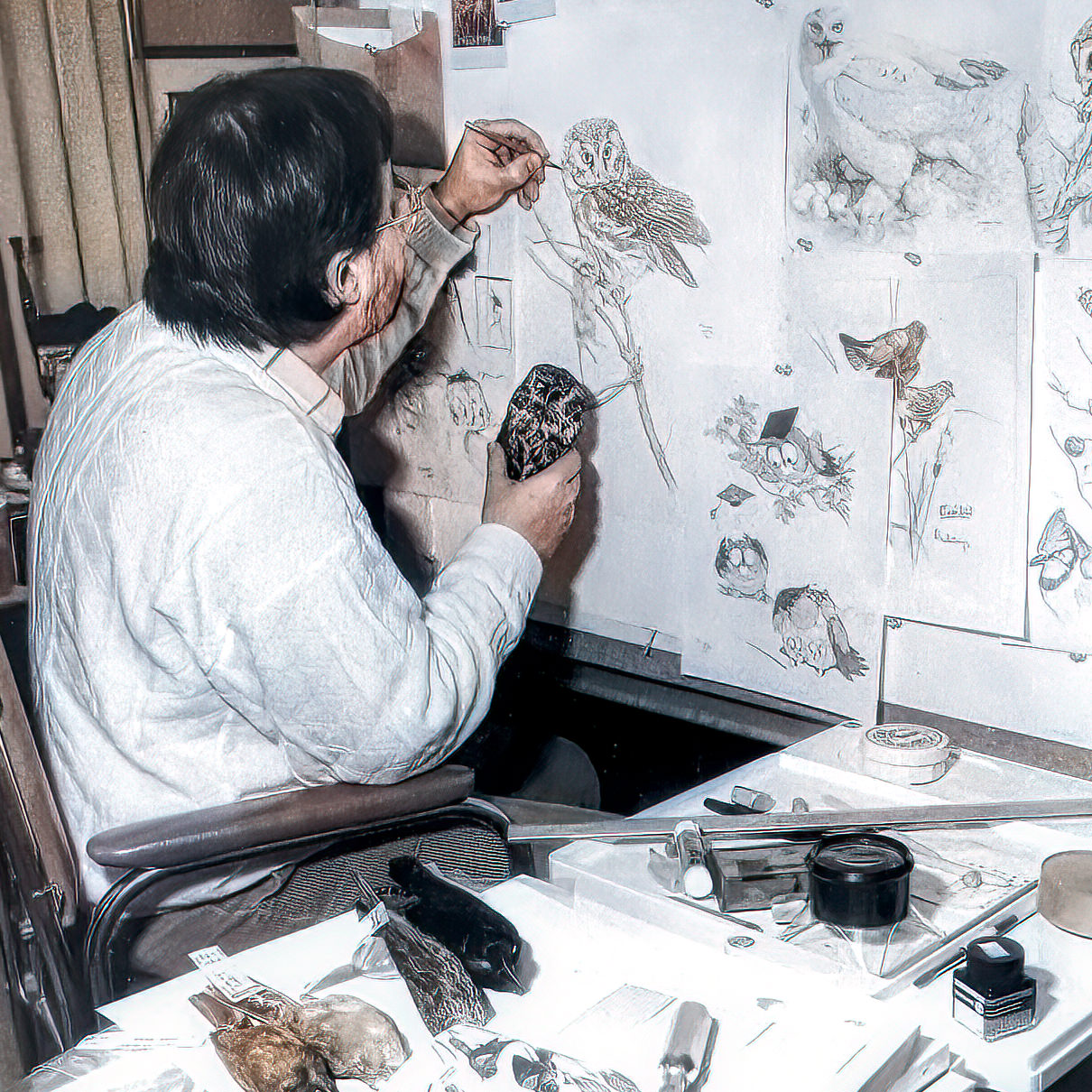
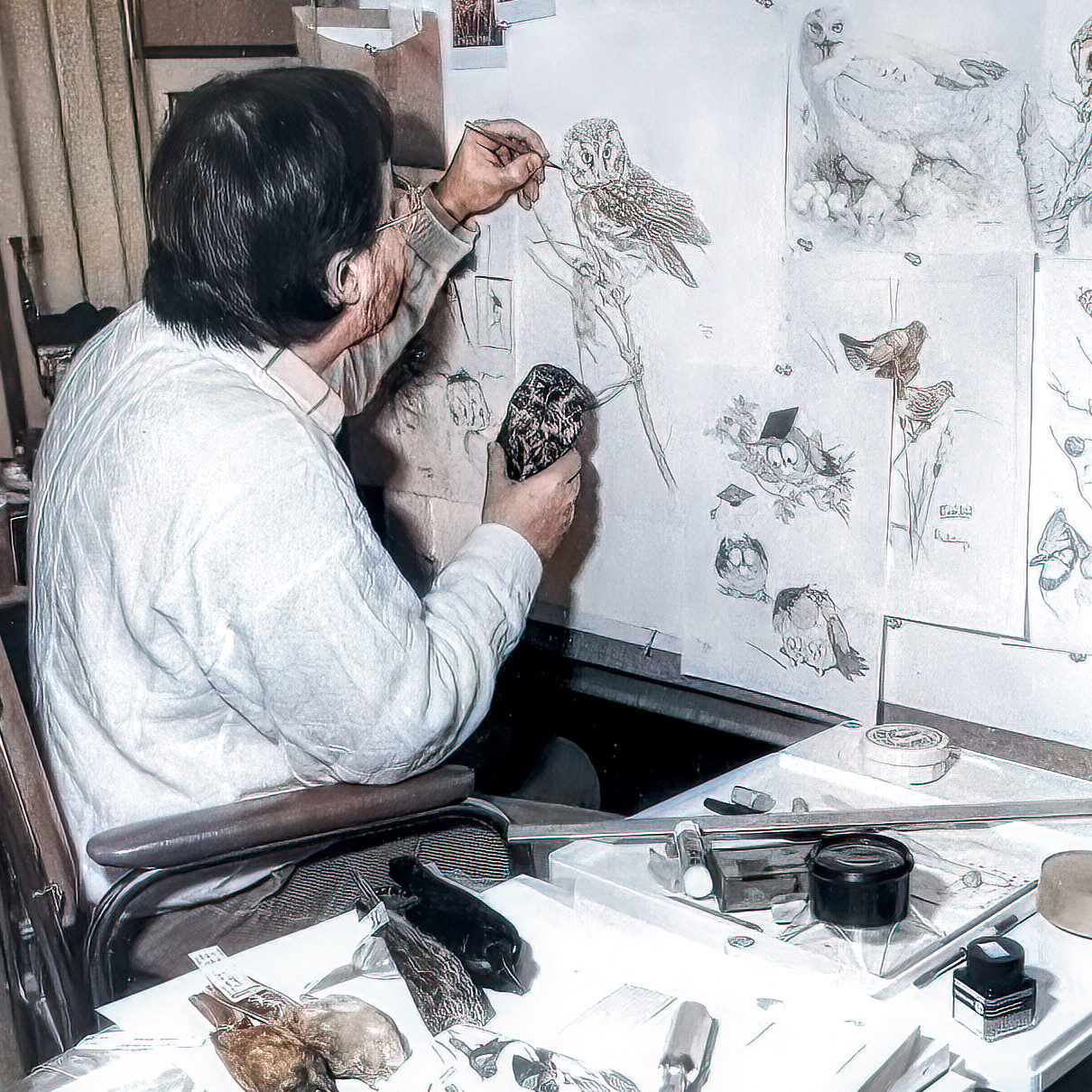
He is holding a boreal owl up to his own eye.
His right hand is raised, the specimen pinched carefully between his fingers, suspended a few inches from the sheet he is drawing on. The pencil is in his left hand, already moving. The distance his eye travels between the bird and the paper is about the width of a hand. That is the whole method, really. Close the gap until there is nothing left to guess.
And on the board in front of him, the same owl is alive. It has come down onto a branch with a mouse in its talons. The bird in his hand is still. The bird on the paper is not.
Around the drawing, the wall is covered edge to edge. An owl's face built from thousands of separate strokes, each one laid in the direction the barring actually runs. A bird lowering itself into a nest. More owls, and then at the margins a jay, a warbler, a few moths.
None of it belongs to the owl on the board. These are other pieces, from other projects and other months, pinned up because he likes having his own work where he can see it. What the photograph records by accident is how many different animals he could carry in his head at one time.
Three sources, and what each one was for
Wildlife painting in the twentieth century mostly ran on impressions. An artist would go out, watch, remember, and come home to render the feeling of the thing. The result could be beautiful. It was rarely accurate, and it did not need to be. Nobody was checking.
My father took a harder route, and he took it early. I do not have to guess at his reasoning, because he wrote it down.
The field was for anatomy and movement. He was emphatic that an animal has to be seen and sketched in its own habitat as much as possible, and he called that a vital necessity. Not a preference. A necessity. He would produce as many as forty-five rough pencil sketches of one animal trying to capture the whole range of how it moved.
Live animals at close range were for expression. Eye colour, the exact cast of a look, the texture of a coat. These, he said, you can only get by watching a living creature at leisure from very close up, which in practice meant zoos and compounds. For the owl series of 1972 it meant a private sanctuary at St. Catharines, Ontario, run by Larry and Kay McKeever, who took in injured owls and nursed them. Nearly every species native to Canada passed through their care at some point. He went back again and again, and called it a tremendous opportunity to study owls at close range. Seventeen species came out of that period, the Boreal among them.
Specimens were for feather and fur. In his own written account of how he works, he put it plainly: for the details of feathers and fur he always used skins and pelts lent to him by the Royal Ontario Museum. That is what the 1979 photograph shows. A specimen holds a wing open for as long as you need it to. A living owl will not.
He carried the habitat home too. On field trips he collected rocks, grasses and vegetation and brought them back to the studio for examination, so the setting would be as true as the animal standing in it. The golden eagle in one of his paintings perches on granite veined with rose quartz, a formation from the Algoma region where he made the preliminary sketches.
And when he had finished, he took the sketches and studies to the experts at the Royal Ontario Museum and asked them to confirm he had got it right.
Three sources, each doing a job the others could not. Movement from the wild. Expression from the living animal. Structure from the specimen. Then his own judgment, fusing them into a bird that had never quite existed and yet could not be faulted.
The charge
The word that followed his work was photographic.
It was not meant kindly. Behind it sat the assumption that precision and artistry are opposites, that the more exactly you render a thing the less you are doing as an artist, and that a man who counts feathers is a very skilled copyist rather than a painter.
What is striking, reading what he wrote about it later, is how little rancour there is. He says the critics were generally very kind to him, that much of what they told him was solid and valid, and that where the comment was negative it was largely down to his own ignorance at the time. He learned from it and moved on.
What he refuses is the category. And his answer to it is not a defence. It is a description of intent.
He wants you to feel cold looking at the snow. He wants the summer air, and the sound of dry leaves under a foot. And he points out the thing that settles the argument: a photograph cannot compose. It records what was in front of the lens at one instant. It cannot put the owl on that branch, in that light, at the moment the mouse is taken, because that moment has to be built out of a hundred separate observations gathered over years.
That is the difference between accuracy and mere recording, and he understood it perfectly well while people were still using the word photographic as an insult.
Consider who else has been accused of caring too much about anatomy. Leonardo dissected bodies by candlelight to understand how a shoulder moves. Dürer drew a hare in 1502 with every guard hair placed, and it remains, five centuries on, one of the most looked-at objects in Vienna. Audubon posed his birds precisely so he could get the wing angle right. Nobody argues that these men were technicians who stumbled into art.
At a certain level of attention, precision stops being the opposite of artistry and becomes the vehicle for it. You cannot make someone feel the aliveness of an owl by approximating an owl.
What the ornithologists said
There is a kind of validation that matters more than a warm review in an arts column.
In March 1974, Cornell University's Department of Ornithology invited him to exhibit at Sapsucker Woods in New York, one of the most serious centres of ornithology anywhere. More than forty works went on the walls. The show was arranged by Olin Sewall Pettingill Jr., then director of the department, with his assistant director Douglas A. Lancaster.
The point is who had hung there before him. Louis Agassiz Fuertes. Sir Peter Scott. Roger Tory Peterson.
The audience at Sapsucker Woods was not there to admire brushwork. They were there to check whether the birds were right. The university's newsletter, not a publication given to enthusiasm, praised the work at length.
The same year, he was elected to full membership of the Royal Canadian Academy of Arts, the first wildlife painter invited to join.
The part that cannot be repeated
My father is in his eighties. He still draws, and I hope he always will. But he works at his own pace now, and that pace is not what it was. A man who once made forty-five sketches before starting a painting is not going to build a second body of work. What is here, in the main, is what there will be.
And the method that produced it has effectively vanished. It required a sanctuary willing to let a young man sit with its patients, museums willing to lend, a tolerance for spending weeks on a single wing, and a level of attention that the current economics of illustration cannot support. There is no one coming along behind him doing this. There is no way to do it faster.
I think about Japanese swordsmiths, the ones who spent forty years learning to fold steel and then died without an apprentice. The objects survive. The discipline does not.
That is why this gallery exists, and why we hold the work rather than scattering it. Every piece in it is a record of a man sitting inches from his subject in order to get it right, feather by feather, because getting it right was the whole point.
The finished painting exists. It sold, a long time ago, to a private collector, and I have never seen it in person as an adult. Somewhere there is a wall with a boreal owl on it, coming down onto a branch, and whoever walks past it every day probably has no idea that the bird it was drawn from was held up in my father's hand, at arm's length, in a room in Toronto in 1979.
The owls are here, with the rest of the birds.
Michael Loates, Owner
Glen Loates R.C.A., Artist


Kerry Gray
August 26, 2026
Michael, thank you so much for this article. It elevated my appreciation for your father’s work and made me more happy to have several prints of his work on display in my home. I’m delighted you are keeping your father’s work ‘alive’ for future generations.