





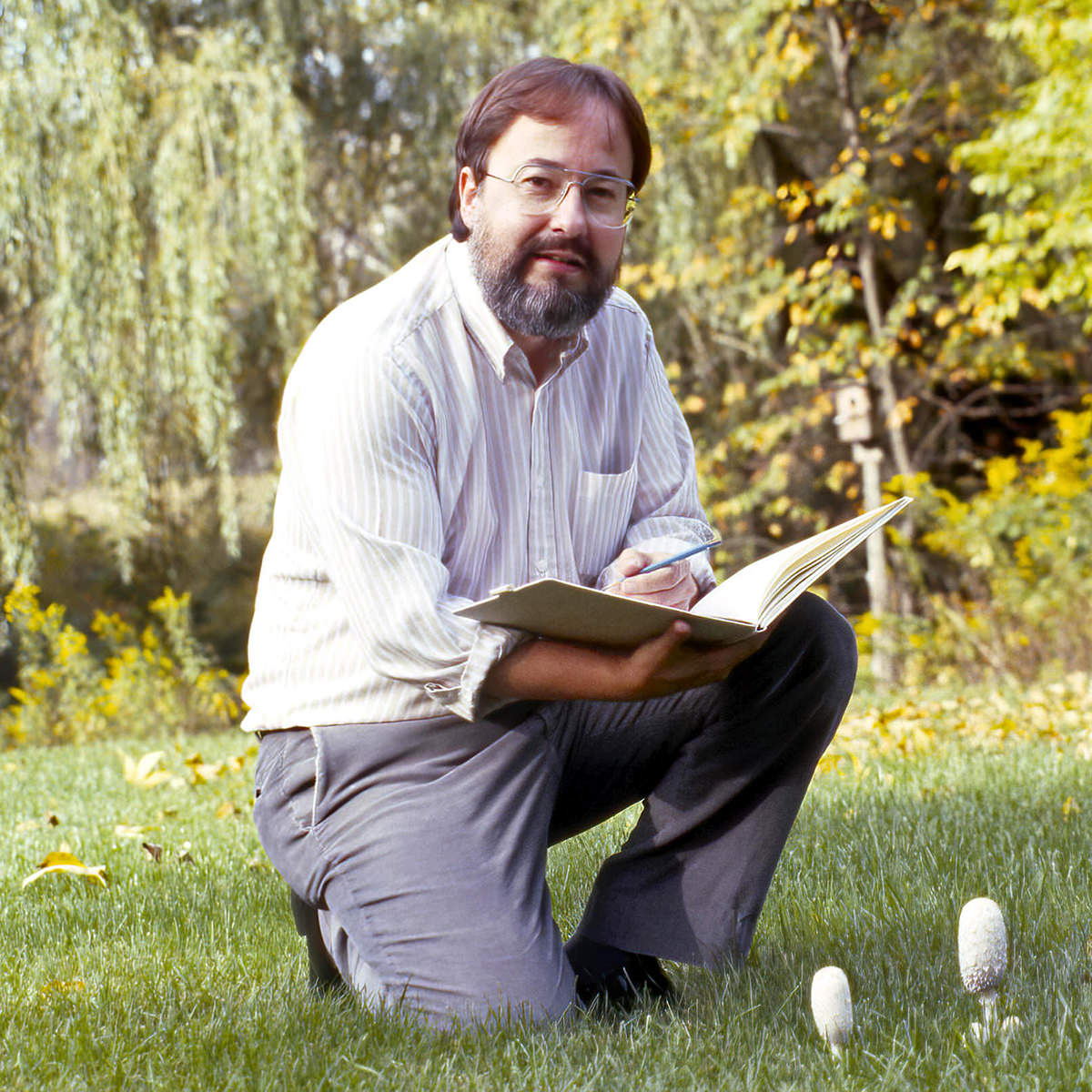
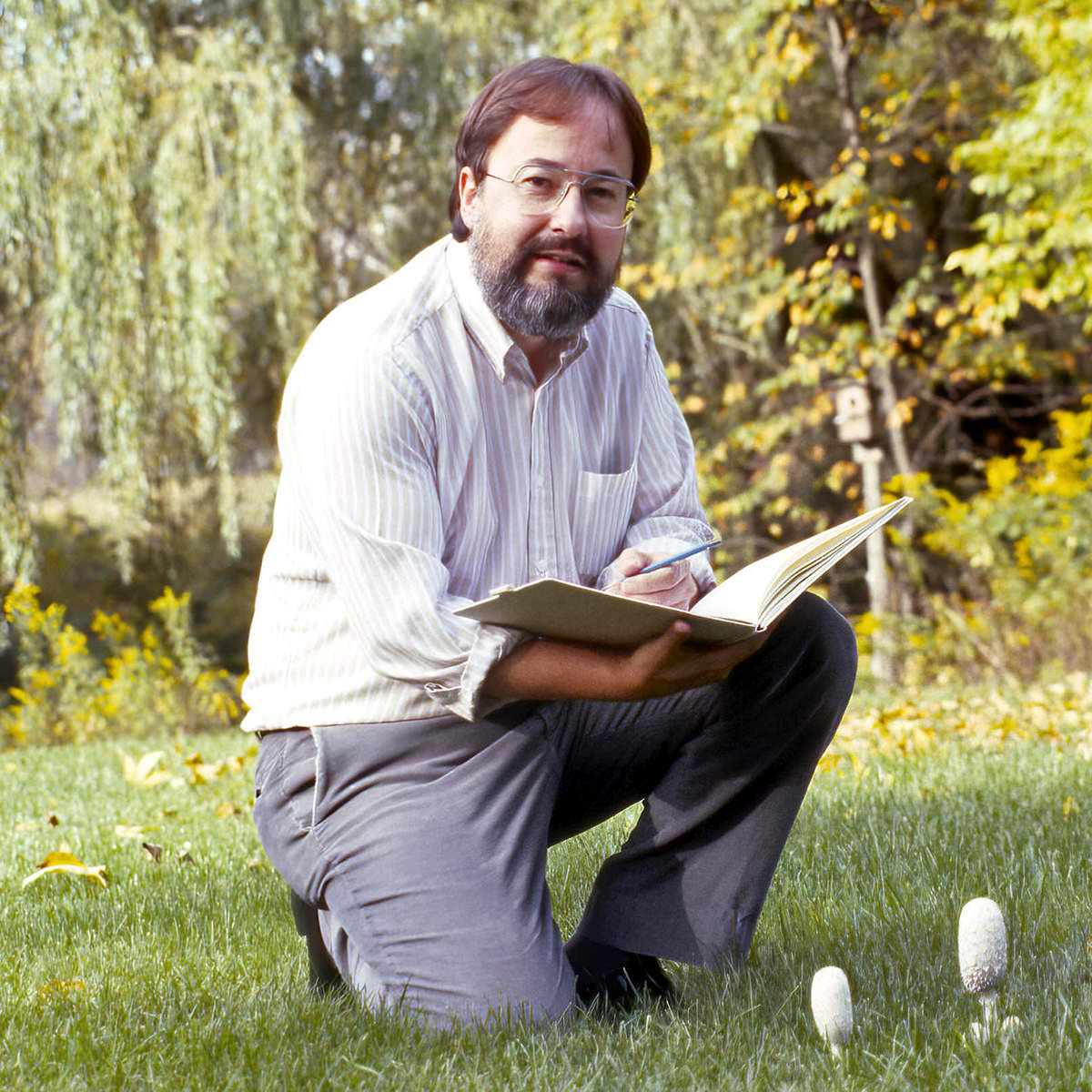
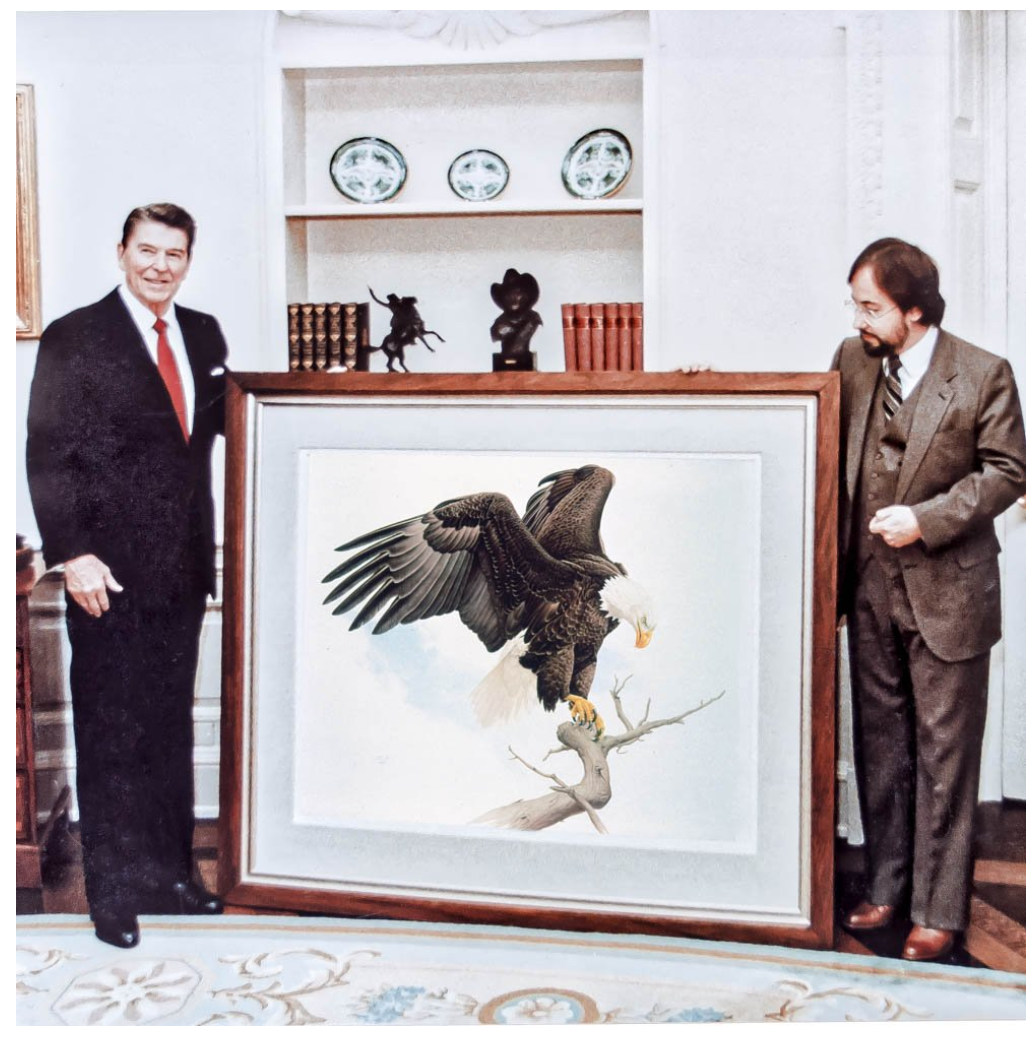
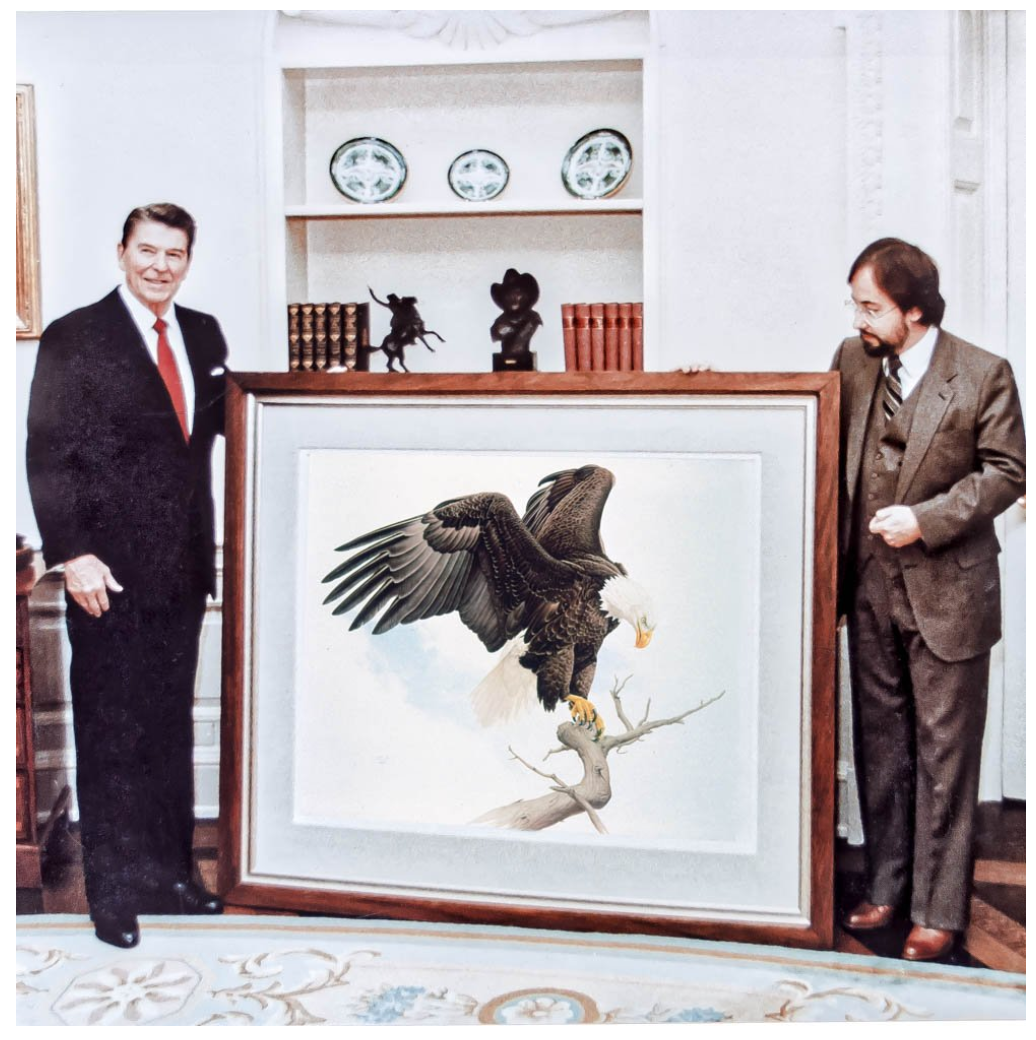


Above: President Ronald Reagan receiving 'The Bald Eagle' from Glen Loates in 1982
Listen to this story · 9 min
From 15 February to 15 May 1985, the Royal Ontario Museum gave Glen Loates a solo exhibition. It ran for three months and it was called Glen Loates: A Brush with Life, after the book Glen Warner had published the year before.
It came three years after The Bald Eagle had been presented to President Ronald Reagan in the Oval Office. The painting was loaned back to the museum for the show.
What that exhibition really marked, though, was twenty years of a relationship that had started when he was a fifteen-year-old with no qualifications and nowhere to go.
Nothing we can teach you
My father left Northmount Junior High in Willowdale in December of his ninth-grade year. He was good at art and good at science, and poor at everything else, and by then it was clear which way it was going to go. His science teacher, Stewart Calvert, a natural history enthusiast who had spent two years encouraging him to illustrate his own essays, told my grandparents the boy should leave and go to art school.
So he went to the Ontario College of Art, hoping to enrol in a course on animal anatomy.
No such course existed.
The college's president, Sydney Watson, went through the portfolio of nature studies and turned the application down. The official reason was that Glen did not have enough academic credits. The second reason, and the one Watson seems to have actually meant, was that a boy already this far along in a field the college did not teach would get nothing useful out of its courses. As one of his biographers puts it, there was nothing the college could teach Glen that he did not already know.
Watson admired the work and told him to go and pursue it.
He tried the commercial art houses next, and got nowhere without a diploma. He enrolled in a commercial art course at a private school in Toronto, learned lettering and layout and design inside a few months, decided he had no interest in becoming a designer of chocolate boxes and disposable coffee cups, and dropped out.
Which left a fifteen-year-old with a portfolio, no school, and no job.
What he had instead was a museum
He was introduced to Jim Baillie, an ornithologist at the Royal Ontario Museum and one of Canada's leading writers on bird life. Baillie recognised something, and did the single most useful thing anyone could have done: he gave him free access to the museum's entire collection of bird and mammal specimens, and walked him around the building introducing him to staff who might help.
One of them was Terence Shortt, the ROM's chief artist and one of the finest bird painters in the country.
That access is the origin of everything. The study skins, the wings held open on a work table, the barbs counted onto a sheet of paper. Sydney Watson had been right that there was no course for this. What there was instead was a drawer of specimens and a curator willing to open it.
The first show, 1965
Shortt organised his first one-man exhibition. Around fifty paintings and drawings went on view at the museum from 25 October to 22 November 1965. Shortt had done the same thing a few years earlier for another young bird painter, Fenwick Lansdowne.
His reasoning is recorded in our archive, and it is worth quoting because it explains why a natural history museum was doing the work an art gallery should have been doing.
"I feel that these exhibitions for young wildlife artists should be a vital part of the museum's function. After all, where else were these artists to go?"
At the time, public and commercial galleries in Canada showed no interest in wildlife art. The museum was not being generous. It was filling a gap nobody else would.
That exhibition introduced him to an audience that included collectors who stayed with him for decades. It travelled on, with additional work, to the Museum of Natural History in Buffalo.
1975: hung beside his heroes
Ten years later the ROM staged Animals in Art, gathering the best contemporary wildlife painting from around the world alongside historical masterpieces. Glen's contribution was Red Fox and Ring-Necked Pheasant, a major watercolour completed that year.
It hung beside Audubon, Fuertes and Thorburn.
He had grown up copying those three out of books. It was the first time he had ever seen the originals.
1985: in his own words
In our archives we found the artist statement Glen wrote for the 1985 exhibition. We reproduce it here in full.
"All artists have their own reasons for painting, but there is, I believe, a universal experience and understanding in the painting of animals that everyone can share. I am a self-taught artist who enjoys experimenting and accepting new challenges with every painting I create. I am constantly striving to improve my technical skills and continue to learn as I interpret nature on paper.
In my father's studio, I made my first attempts to draw what I had actually seen in nature. There was a light on the back porch that used to attract moths. I was fascinated by the delicate structure of their wings, so I captured some specimens and tried to sketch the intricate patterns using pencils and crayons. As an exercise, it was the best thing I could have done. I drew the moths over and over again until they looked right to me.
By 1954, I was making [a] little "flipbook," in which I drew the progression of an animal's movement on consecutive pages of a notepad. When quickly thumbed, these created a nice approximation of movement. I wanted to get the feeling of how a bird flies or mammals walk and jump.
To this day, I try to portray this sense of animation in my art. As many as forty-five rough pencil sketches may be necessary to record the movements and anatomy of an animal or bird.
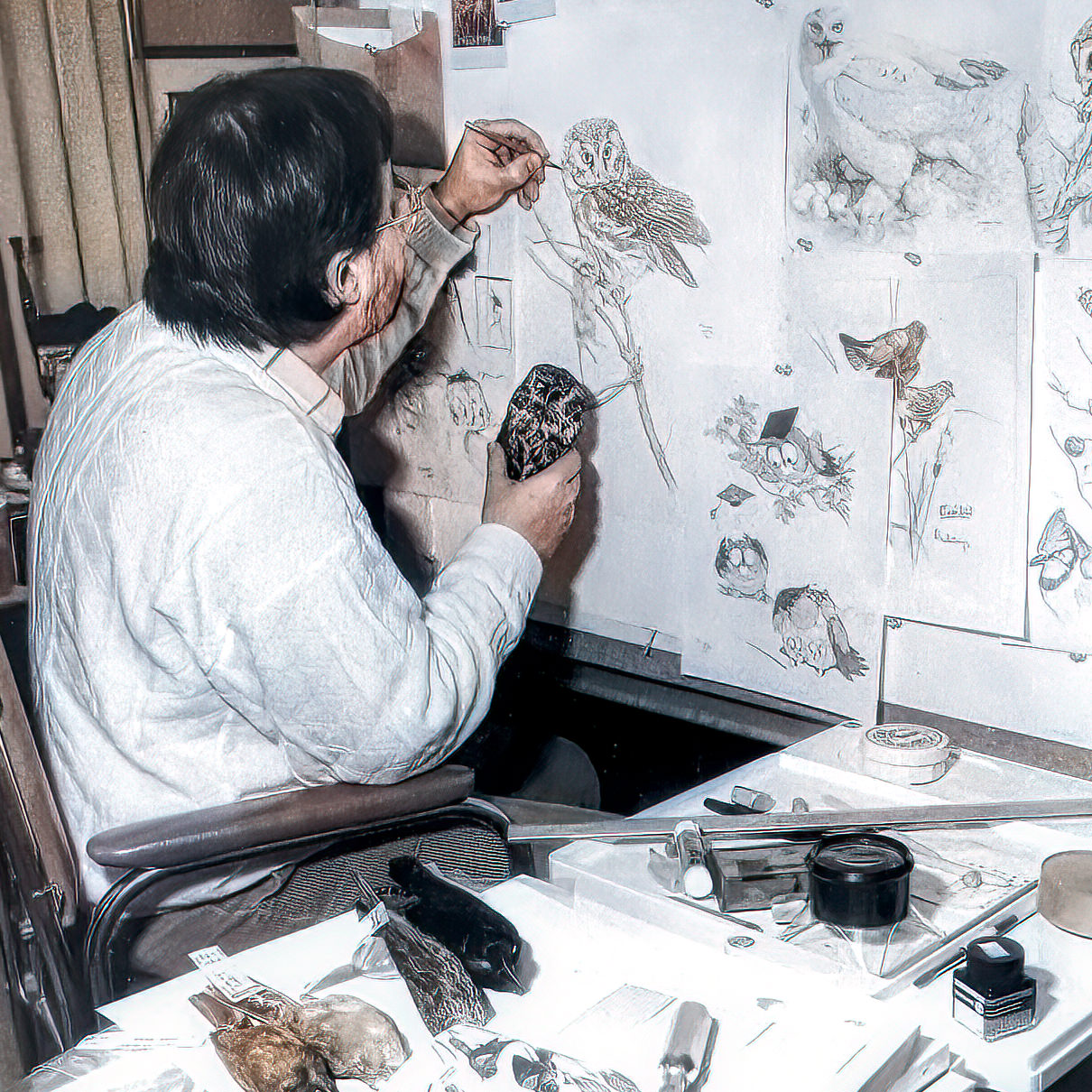
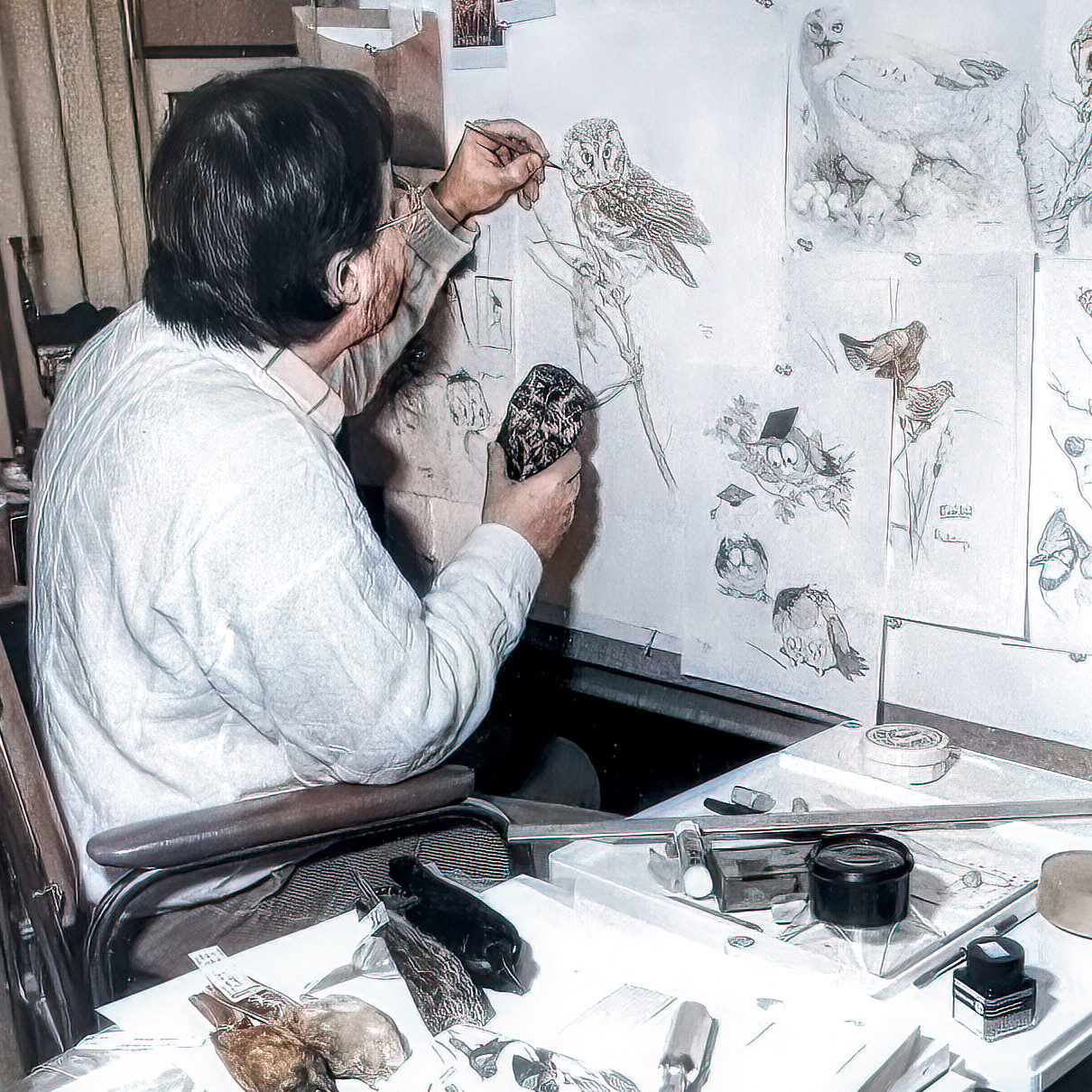
For the details of feathers and fur, I use skins and pelts loaned to me by the Royal Ontario Museum. Many curators of the museum's life sciences departments deserve much credit for their endless encouragement and help. Terence Shortt, the museum's past chief artist, shares his experiences and knowledge with me.
I always start each animal painting by completing the eye of the subject first and painting the background detail last. I prefer to use watercolour paint, but occasionally I work with pastels and ink. While it may be necessary to use photographs for reference, I avoid it if possible. My field sketches and colour notes, as well as my sensory experience on location, have the greatest influence on the quality of the pictures I make."

Above: the original artist statement, 1985
Notice that Terence Shortt is in it. Twenty years after arranging the first show, he is still named, in the present tense.
Two things worth pausing on
The first is the eye. He begins every animal painting by finishing the eye before anything else, and paints the background last. Elsewhere he is blunter about why: if the eye does not have the right life in it, there is no sense going on, and he destroys the sheet and starts again.
The second is the number. Forty-five sketches, of one animal, before the painting starts.
It did not end in 1985
He came back. An auction for the museum in 1987, and a group exhibition, The Art of Survival, from December 1987 into February 1988.
Sixty years on, the arrangement that began with Jim Baillie handing a teenager the keys to a specimen collection is still the thing his work rests on. Every feather in this gallery was checked against something a curator lent him.
Michael Loates, Owner
Glen Loates R.C.A., Artist


Leave a comment (all fields required)