




Many people come to us after inheriting a framed piece, or after buying one at auction, wanting to know what they have. This will tell you what you own. It will not tell you what it is worth, and further down we explain why.
Many people come to us after inheriting a framed piece, or after buying one at auction, wanting to know what they have. This will tell you what you own. It will not tell you what it is worth, and further down we explain why.
Question 1 of 8
Question 2 of 8
Part of the artwork, in the same medium as the image. Look in the lower corners.
Question 3 of 8
On the blank paper outside the image, in graphite rather than ink or paint.
Question 4 of 8
Question 5 of 8
Use a magnifying glass, or your phone camera zoomed in as far as it goes, on an area of flat colour.
Question 6 of 8
Question 7 of 8
First, the size of the sheet itself, not the frame or the mat.
Second, look closely at the painted signature. If there is a year painted underneath it, in the same colour, write it here. It is often faint.
Question 8 of 8
A figure issued by the artist's family carries no weight with an independent appraiser or an insurer. It is not independent, and everyone in that business knows it. A record of what a piece actually is carries weight, and it is something only we can provide.
If you need a valuation for insurance, an estate, or a sale, go to an accredited independent appraiser. In Canada, the Canadian Personal Property Appraisers Group and the International Society of Appraisers both maintain directories.
A figure issued by the artist's family carries no weight with an independent appraiser or an insurer. It is not independent, and everyone in that business knows it. A record of what a piece actually is carries weight, and it is something only we can provide.
If you need a valuation for insurance, an estate, or a sale, go to an accredited independent appraiser. In Canada, the Canadian Personal Property Appraisers Group and the International Society of Appraisers both maintain directories.
A price realised at auction records one thing: what two people were willing to pay on one afternoon, for a lot described in whatever detail the catalogue happened to carry. It is a transaction. It is not an appraisal, and it is not a judgement on the work.
We have watched original paintings listed in fourteen words, with no provenance, no exhibition history, and an estimate drawn from unrelated results. Often the people writing those listings had nothing to work from. The archive that would have told them what they were holding sits here, and no one asked for it.
Sometimes there is only one bidder. A price set with no competition in the room is the floor at which a work can change hands. It is not a measure of what the work is.
None of that changes the painting. It changes who noticed it.
This matters more than it sounds, because auction results are permanent and public. They are cited as comparables for the next sale, and the next, until an artist's recorded market has drifted a long way from the work itself.
Who has owned these paintings
The T. Eaton Company bought Glen's work directly from him. The gallery holds the cheques, including one written in 1979 for $37,450 for a single painting.
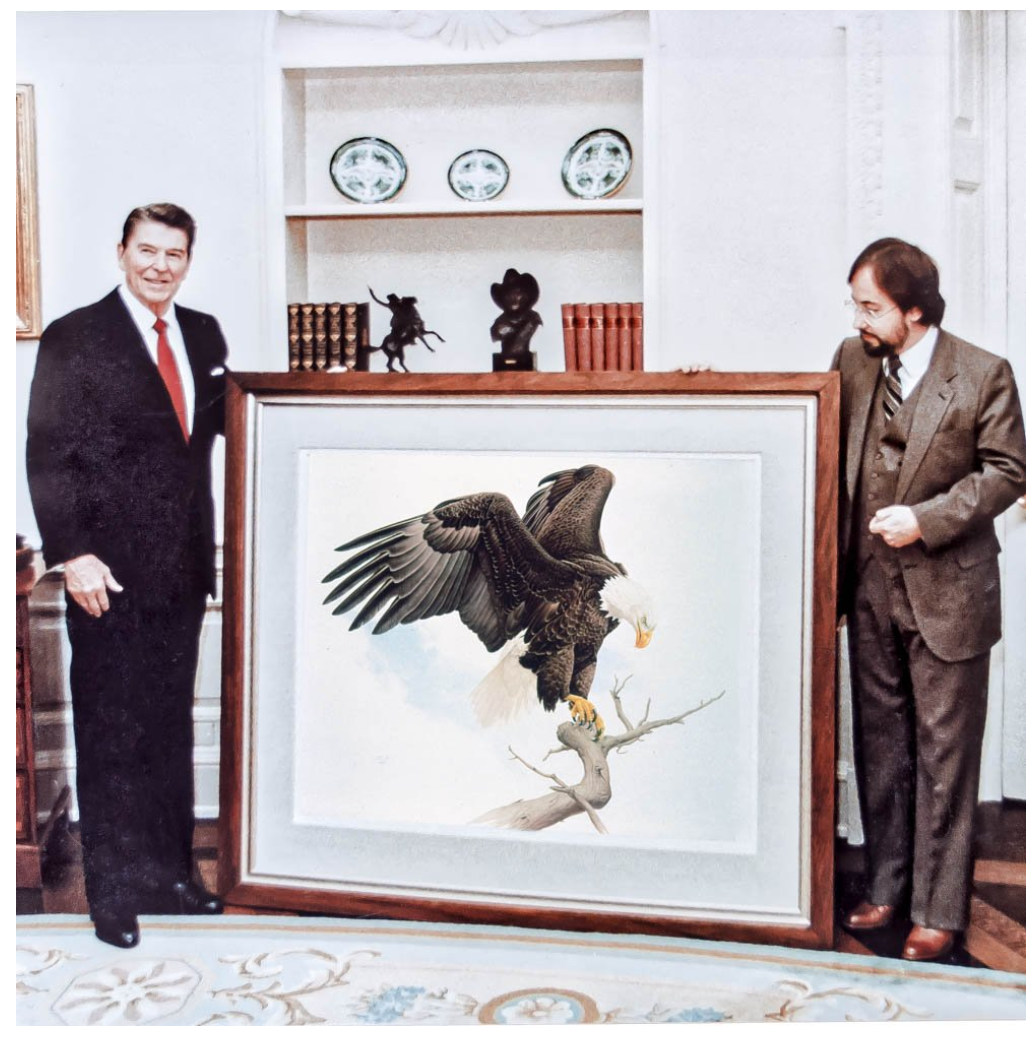
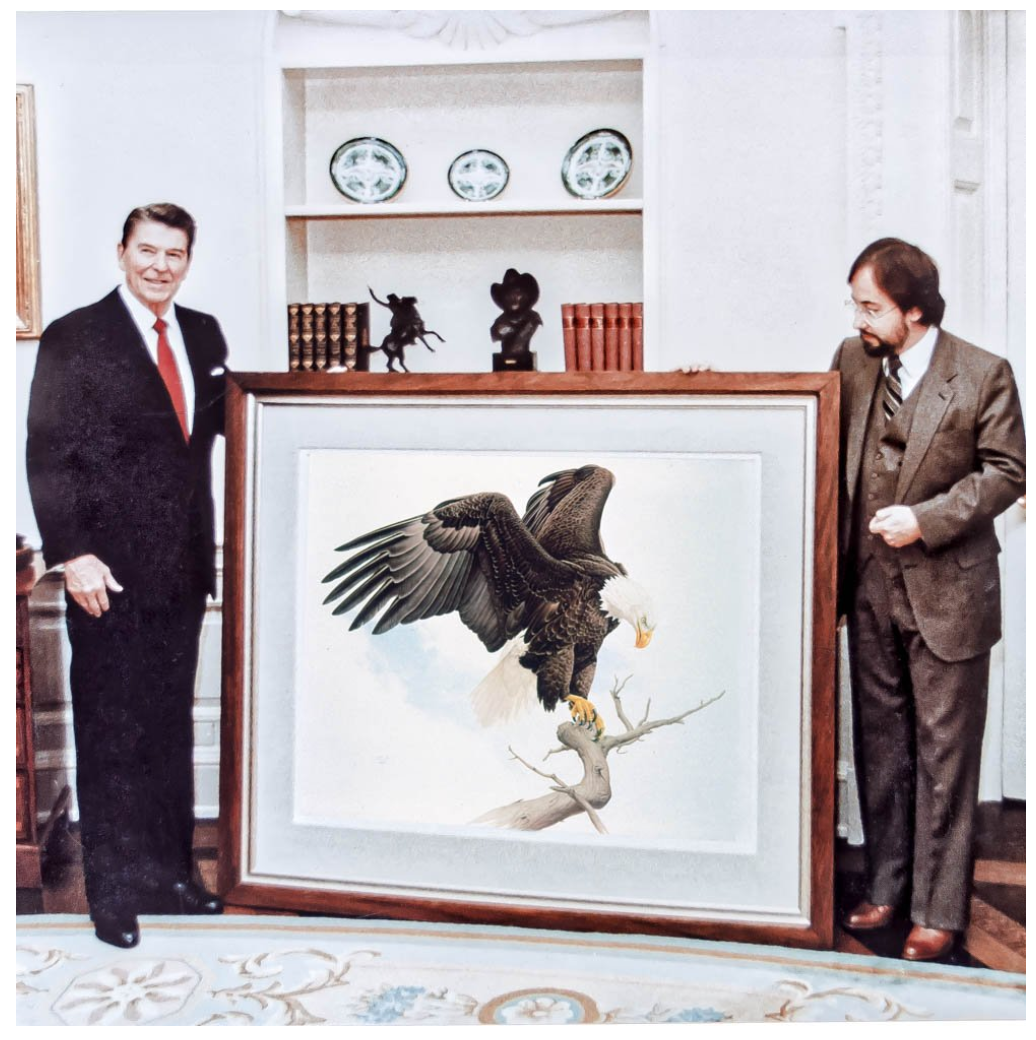
In 1982 the Prime Minister arranged for Glen to present The Bald Eagle to President Reagan in the Oval Office. He was the first Canadian artist represented at the White House.
In the mid-1980s the Electrolux Corporation of America commissioned him to paint their corporate symbol, a Siberian tiger, life size, on a canvas of nearly six by seven feet. The Royal Ontario Museum loaned him a tiger skin, and it stayed in the studio for the length of the work. He spread it on the floor, draped it over the backs of chairs, and held it in his hands, turning it until the fur fell the way he needed to see it. The photographer Ursula Liane was commissioned to record every stage. Her photographs were tipped into a single volume, its text hand-scribed in calligraphy, then bound in leather with gilt edges at the printing house owned by Glen's brother Bernard, and signed by both artist and photographer. Only one was ever made, and it has never been reproduced in any other form. The painting still hangs at the company that succeeded them, four decades on, and their chief executive shows it to visitors. We digitised that book, and it is yours when you join the list.
In 1971 the McMichael Canadian Collection gave him a one-man exhibition, the first it had ever granted a wildlife painter, and more than one hundred thousand people came to see it across seven months. In 1973 the International Edition of Reader's Digest carried his paintings to readers in thirteen languages. In 1974 he was elected to full membership in the Royal Canadian Academy of Arts.
That is the record. Set it beside a recent hammer price and draw your own conclusion.
Where the prices actually come from
When Glen finishes a work, he sets its price, and that price is final. The gallery holds the original price lists and the sales records, alongside the works offered here now. That is the reference we keep.
So we will tell you what you own. Where our records allow, we can also tell you what Glen priced the work at when he finished it, and what it sold for the first time. That is a documented fact rather than an estimate, and it is usually the most useful number anyone can give you. For what it is worth today, we will point you to someone independent. What we will not do is treat the last hammer price as a verdict.
A price realised at auction records one thing: what two people were willing to pay on one afternoon, for a lot described in whatever detail the catalogue happened to carry. It is a transaction. It is not an appraisal, and it is not a judgement on the work.
We have watched original paintings listed in fourteen words, with no provenance, no exhibition history, and an estimate drawn from unrelated results. Often the people writing those listings had nothing to work from. The archive that would have told them what they were holding sits here, and no one asked for it.
Sometimes there is only one bidder. A price set with no competition in the room is the floor at which a work can change hands. It is not a measure of what the work is.
None of that changes the painting. It changes who noticed it.
This matters more than it sounds, because auction results are permanent and public. They are cited as comparables for the next sale, and the next, until an artist's recorded market has drifted a long way from the work itself.
Who has owned these paintings
The T. Eaton Company bought Glen's work directly from him. The gallery holds the cheques, including one written in 1979 for $37,450 for a single painting.
In 1982 the Prime Minister arranged for Glen to present The Bald Eagle to President Reagan in the Oval Office. He was the first Canadian artist represented at the White House.
In the mid-1980s the Electrolux Corporation of America commissioned him to paint their corporate symbol, a Siberian tiger, life size, on a canvas of nearly six by seven feet. The Royal Ontario Museum loaned him a tiger skin, and it stayed in the studio for the length of the work. He spread it on the floor, draped it over the backs of chairs, and held it in his hands, turning it until the fur fell the way he needed to see it. The photographer Ursula Liane was commissioned to record every stage. Her photographs were tipped into a single volume, its text hand-scribed in calligraphy, then bound in leather with gilt edges at the printing house owned by Glen's brother Bernard, and signed by both artist and photographer. Only one was ever made, and it has never been reproduced in any other form. The painting still hangs at the company that succeeded them, four decades on, and their chief executive shows it to visitors. We digitised that book, and it is yours when you join the list.
In 1971 the McMichael Canadian Collection gave him a one-man exhibition, the first it had ever granted a wildlife painter, and more than one hundred thousand people came to see it across seven months. In 1973 the International Edition of Reader's Digest carried his paintings to readers in thirteen languages. In 1974 he was elected to full membership in the Royal Canadian Academy of Arts.
That is the record. Set it beside a recent hammer price and draw your own conclusion.
Where the prices actually come from
When Glen finishes a work, he sets its price, and that price is final. The gallery holds the original price lists and the sales records, alongside the works offered here now. That is the reference we keep.
So we will tell you what you own. Where our records allow, we can also tell you what Glen priced the work at when he finished it, and what it sold for the first time. That is a documented fact rather than an estimate, and it is usually the most useful number anyone can give you. For what it is worth today, we will point you to someone independent. What we will not do is treat the last hammer price as a verdict.
"Few members of the public appreciate the difference between a limited edition print and a limited edition reproduction. My answer to this is to educate the buyer and that is why I have spoken out on this now . . ."
Glen Loates, A Brush with Life,
newsletter, Vol. 1 No. 1
He set out the difference himself. A limited edition reproduction is scanned and printed on a press, signed and numbered, generally on acid-free rag paper. He approved the colour separations, attended the press proofings and authorized the run, and the plates were destroyed afterwards so that decorator reproductions could not be made from that image. A decorator reproduction was photo-mechanical too, offered in several sizes, and sold for less so that more people could live with the picture.
Because the plates were destroyed, a decorator reproduction is never a later printing of a limited edition. They were separate things from the beginning.
He also recorded, in the same newsletter, how little there is: eight to ten original paintings a year.
"Few members of the public appreciate the difference between a limited edition print and a limited edition reproduction. My answer to this is to educate the buyer and that is why I have spoken out on this now . . ."
Glen Loates, A Brush with Life,
newsletter, Vol. 1 No. 1
He set out the difference himself. A limited edition reproduction is scanned and printed on a press, signed and numbered, generally on acid-free rag paper. He approved the colour separations, attended the press proofings and authorized the run, and the plates were destroyed afterwards so that decorator reproductions could not be made from that image. A decorator reproduction was photo-mechanical too, offered in several sizes, and sold for less so that more people could live with the picture.
Because the plates were destroyed, a decorator reproduction is never a later printing of a limited edition. They were separate things from the beginning.
He also recorded, in the same newsletter, how little there is: eight to ten original paintings a year.