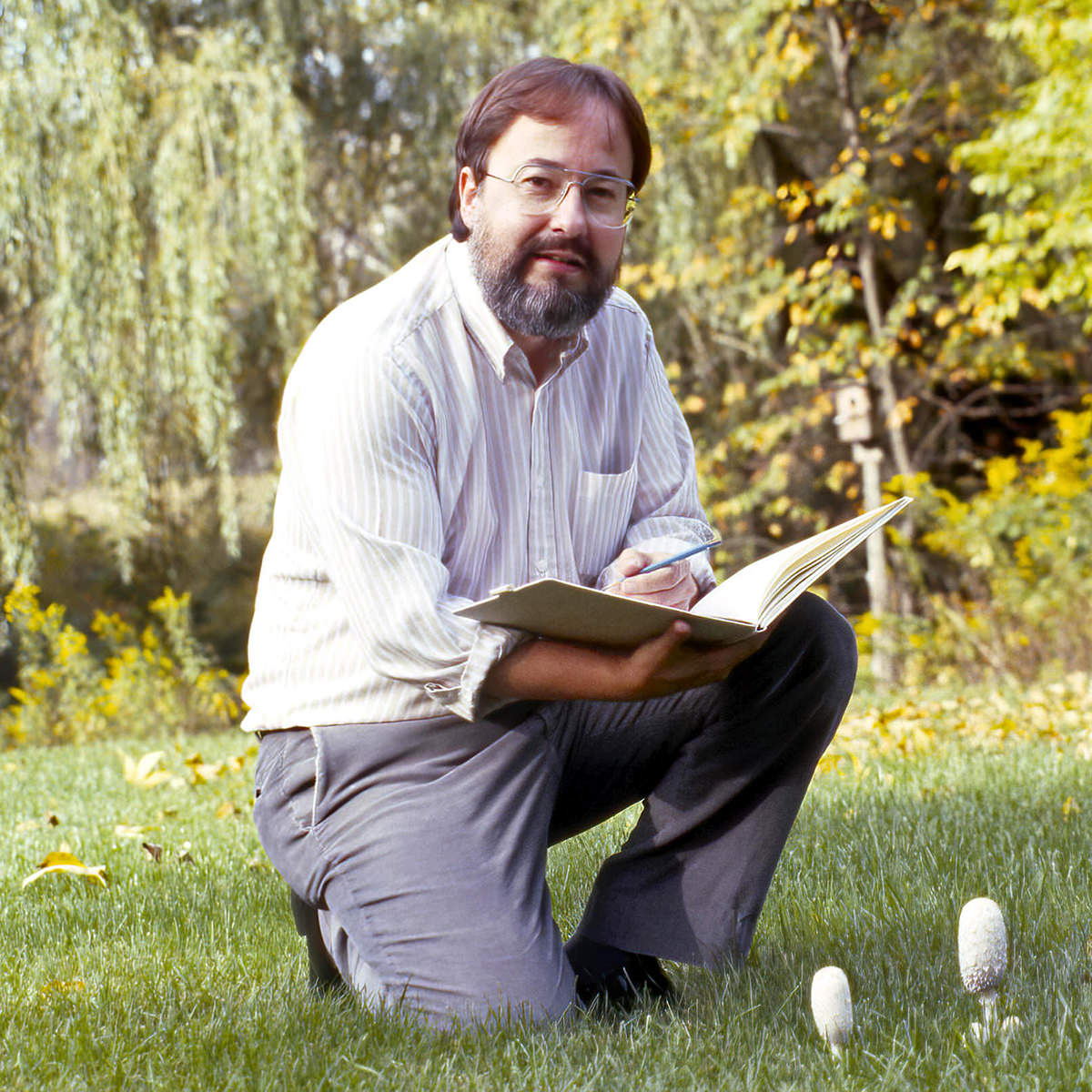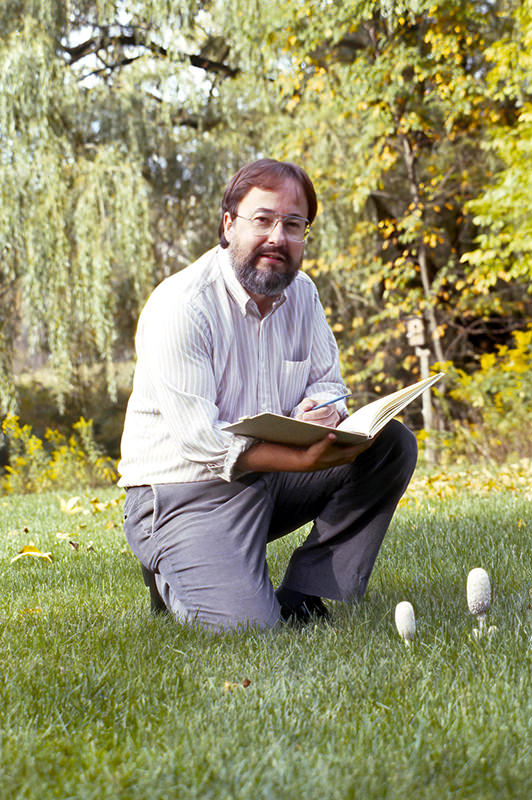




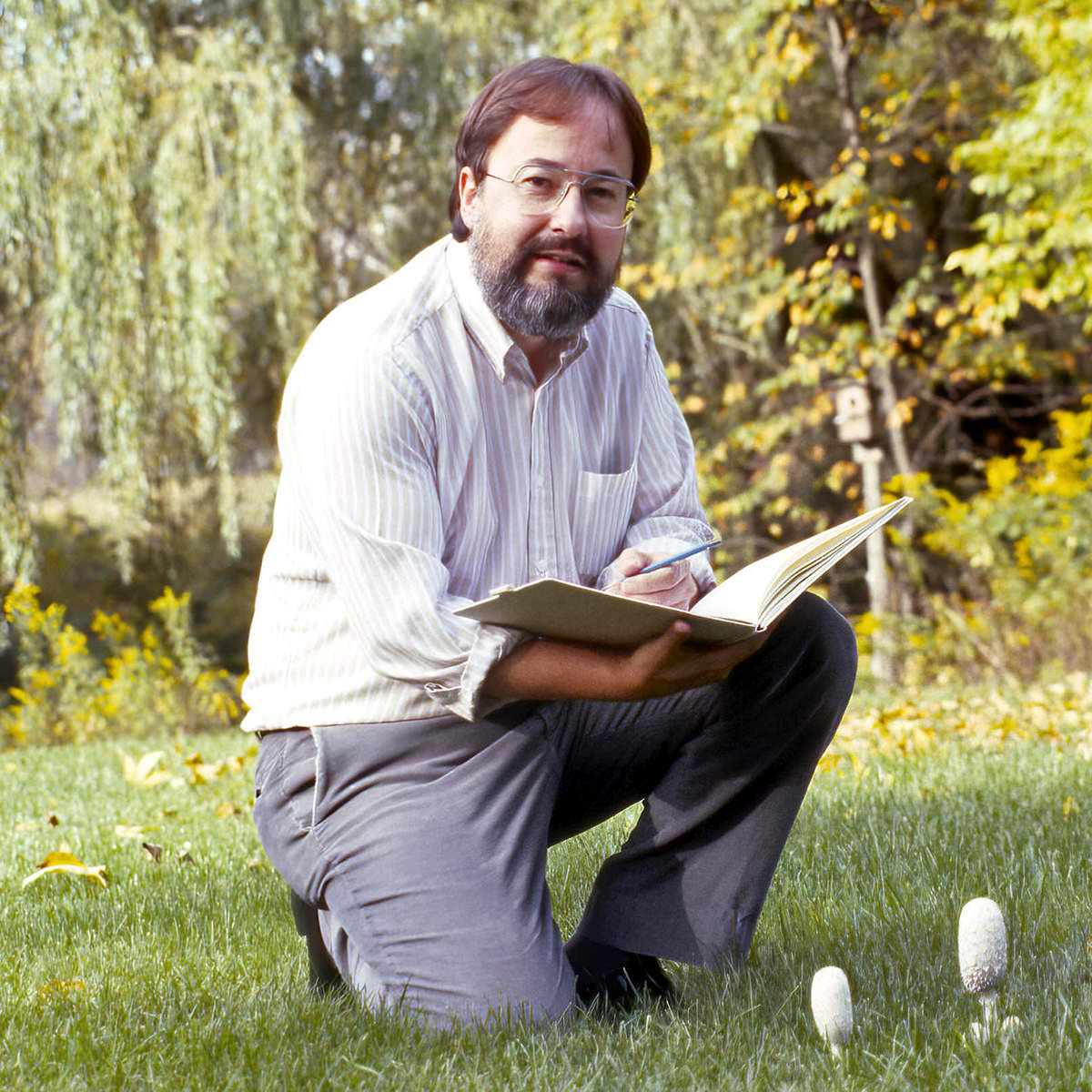
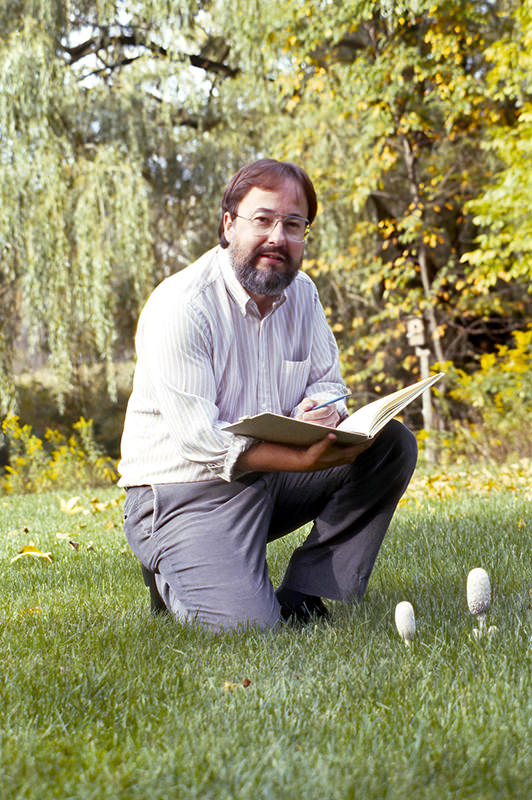
Glen Loates has spent his life paying a particular kind of attention to the natural world — the kind that requires sitting still long enough that the animal forgets you are there, or spending an afternoon with a bird skin from the museum collection until the weight and proportion of the creature are no longer something you are looking at but something you simply know.
He had never attended art school. He never would.
Born in Toronto in 1945, Loates grew up in the ravines of Willowdale, sketching insects, birds, and mammals along the Don River. At seven he was drawing his first animal portraits at Riverdale Zoo. At thirteen he was making the long trip downtown to the Royal Ontario Museum every few months, lifting drawer after drawer of specimen collections under the black light-proof covers, filling sketchbooks with the precise forms of creatures that most people never look at closely. He was already, at thirteen, doing what he would do for the rest of his life.
At eleven he had designed the Canadian Cancer Society's daffodil logo — used by the organization for several decades. But the moment that defined his direction came when he was ten, and a veteran Canadian painter named Fred Brigden came to speak at his school. After the talk, Loates approached him with a pile of drawings. Brigden sorted them into two groups — Disney cartoons on one side, the nature studies on the other. He pointed to the nature drawings and said: "This is where you should be going. That butterfly — it is beautiful because it is from your personal experience and your own feelings about it."
Brigden became the only true teacher Loates ever had. He died within a year of their meeting. Loates later said: "The only way to show my thanks is by doing what I'm doing now."
It was chosen for him. As Loates has said himself: this is not a career — it's a calling.
Glen Loates has spent his life paying a particular kind of attention to the natural world — the kind that requires sitting still long enough that the animal forgets you are there, or spending an afternoon with a bird skin from the museum collection until the weight and proportion of the creature are no longer something you are looking at but something you simply know.
He had never attended art school. He never would.
Born in Toronto in 1945, Loates grew up in the ravines of Willowdale, sketching insects, birds, and mammals along the Don River. At seven he was drawing his first animal portraits at Riverdale Zoo. At thirteen he was making the long trip downtown to the Royal Ontario Museum every few months, lifting drawer after drawer of specimen collections under the black light-proof covers, filling sketchbooks with the precise forms of creatures that most people never look at closely. He was already, at thirteen, doing what he would do for the rest of his life.
At eleven he had designed the Canadian Cancer Society's daffodil logo — used by the organization for several decades. But the moment that defined his direction came when he was ten, and a veteran Canadian painter named Fred Brigden came to speak at his school. After the talk, Loates approached him with a pile of drawings. Brigden sorted them into two groups — Disney cartoons on one side, the nature studies on the other. He pointed to the nature drawings and said: "This is where you should be going. That butterfly — it is beautiful because it is from your personal experience and your own feelings about it."
Brigden became the only true teacher Loates ever had. He died within a year of their meeting. Loates later said: "The only way to show my thanks is by doing what I'm doing now."
It was chosen for him. As Loates has said himself: this is not a career — it's a calling.
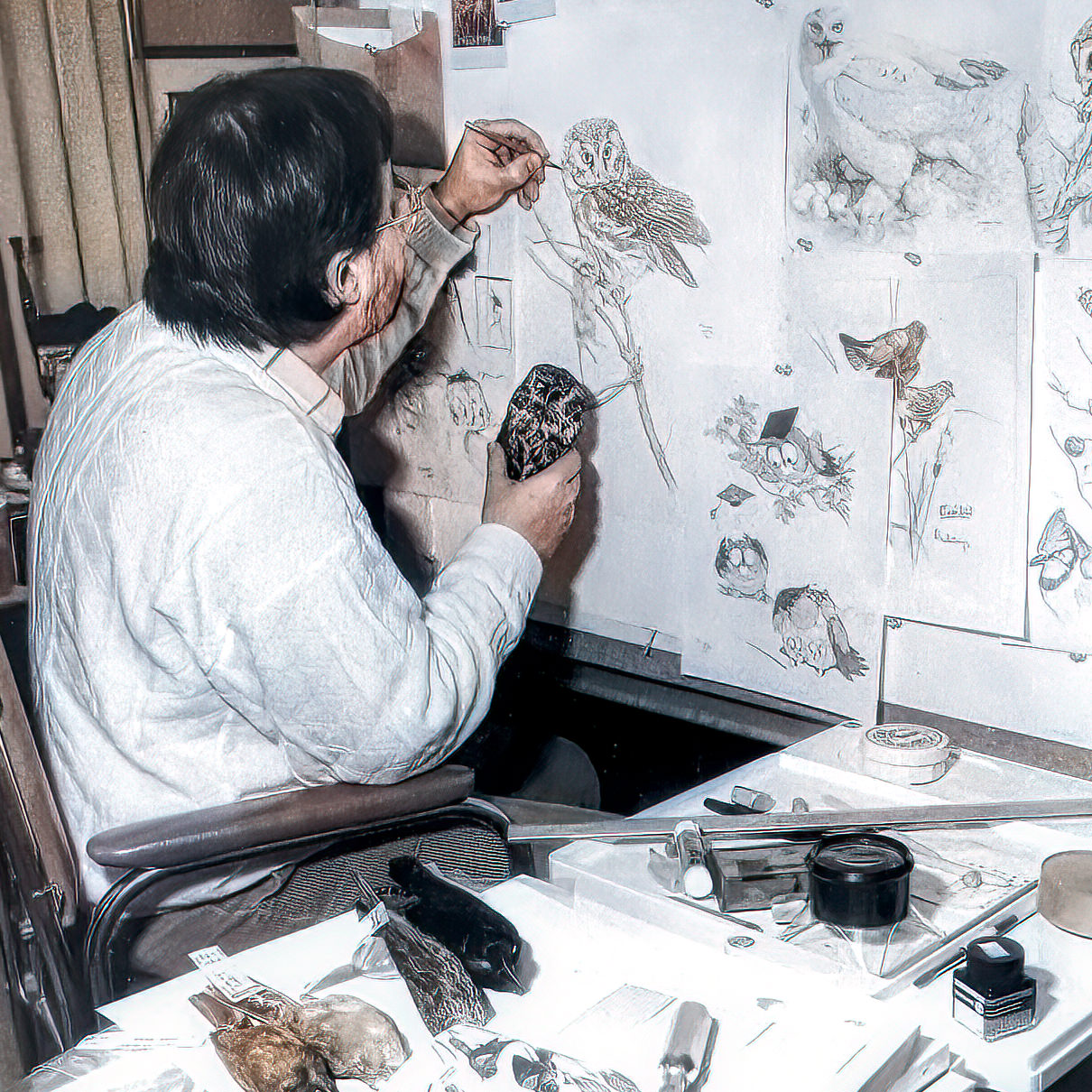
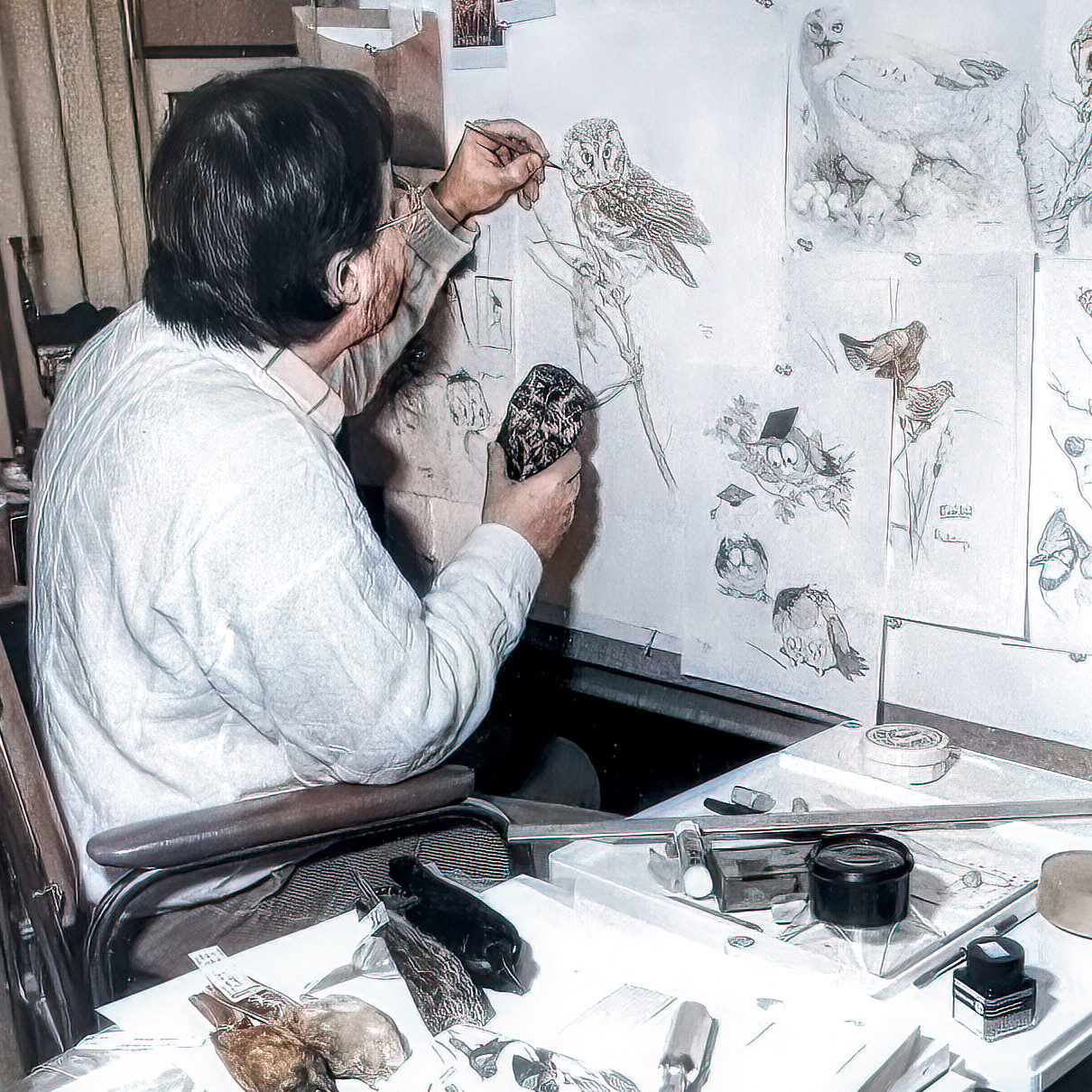
The accuracy in Loates' work is not a stylistic choice. It is the product of a practice built entirely on primary sources. He does not work from photographs. He makes as many as forty-five rough pencil sketches of a single animal before committing it to paint. He works from actual bird skins and animal pelts borrowed from the Royal Ontario Museum — the same institution he visited as a boy — to get the specific weight and proportion of each creature exactly right.
He begins every painting from the eye, working outward. The backgrounds are painted last.
The technique itself is entirely his own invention — watercolour, India ink, and Chinese white drawing ink applied with a specially pointed brush, a method devised through years of experimentation to render the precise textures of fur, feather, and muscle that no conventional approach could achieve. It was never taught anywhere. He developed it himself.
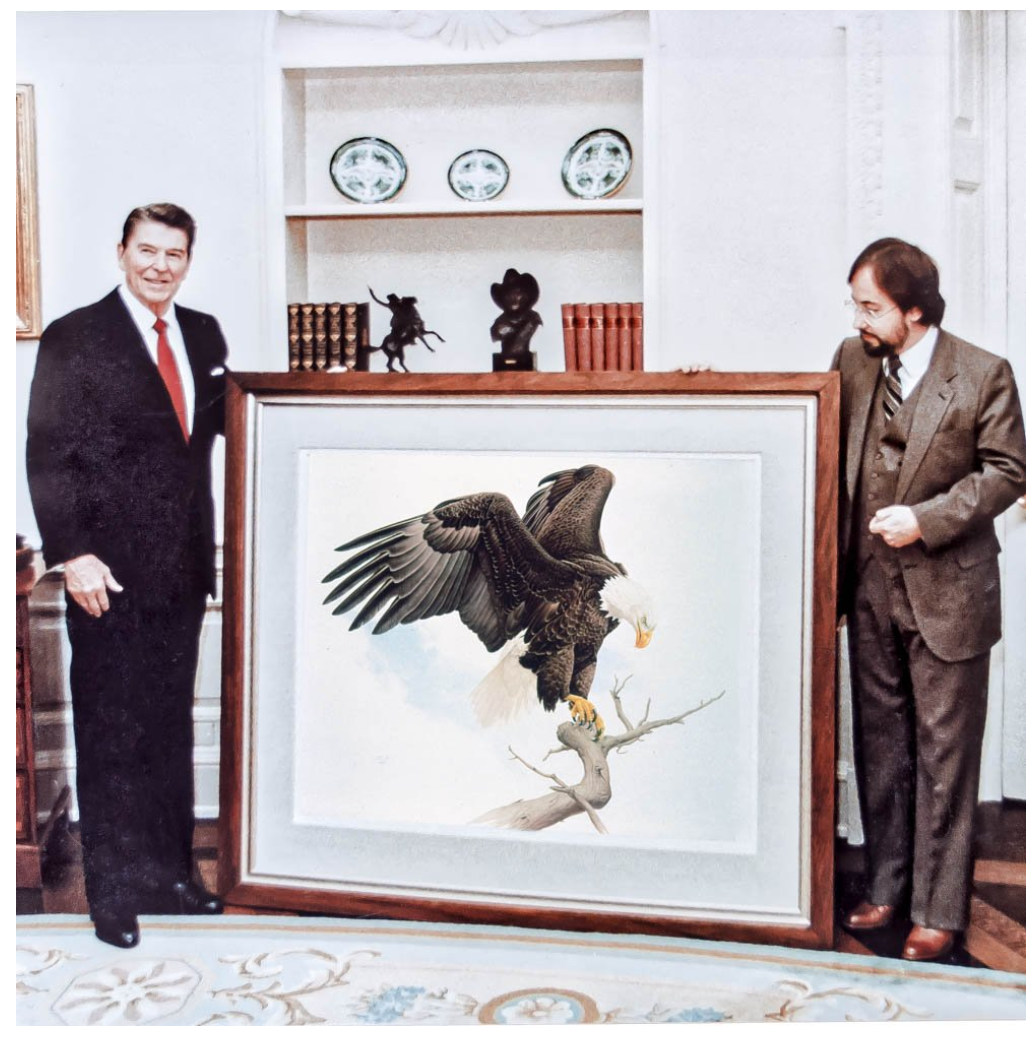
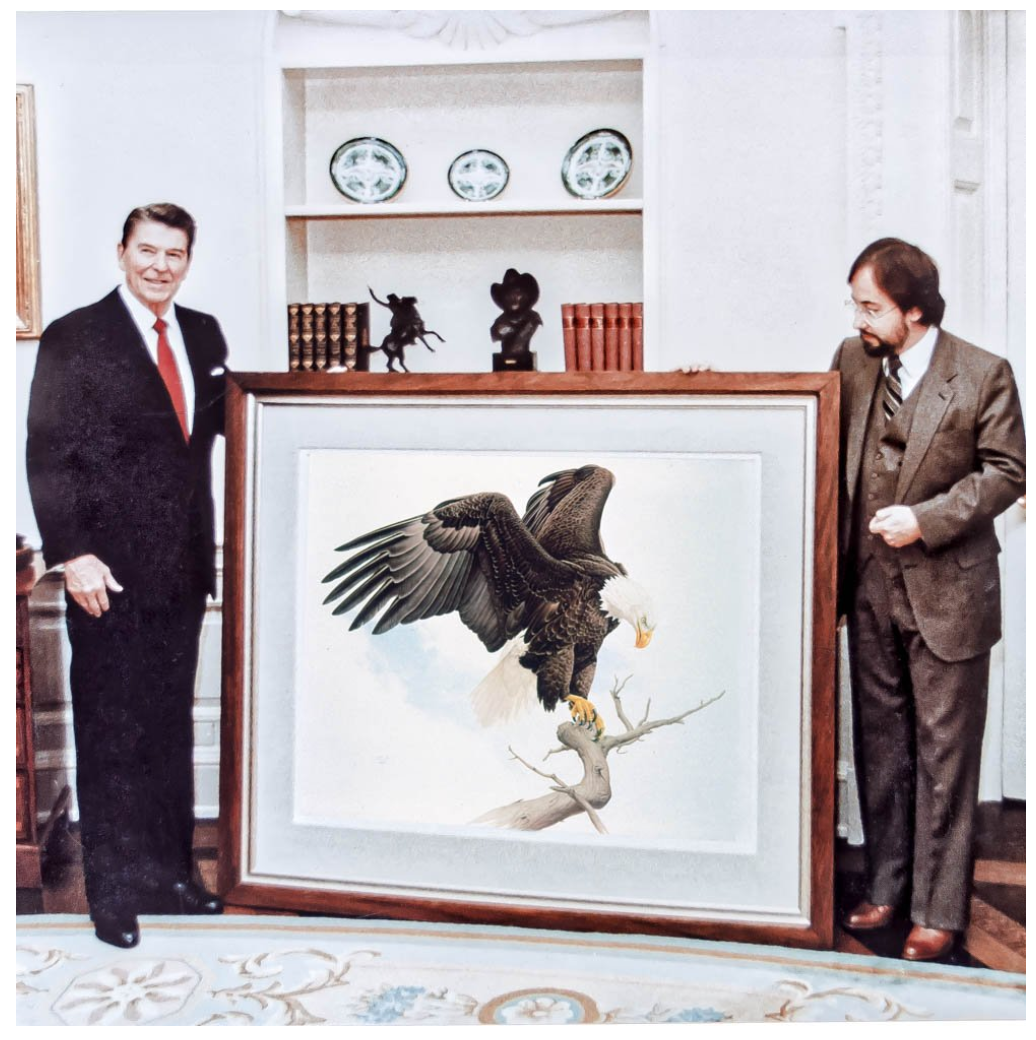
In December 1982, Loates flew to Washington carrying his life-size watercolour of a Bald Eagle — seven months in the making, painted to mark the 200th anniversary of the eagle's designation as America's national symbol. In the Oval Office, accompanied by Canadian Ambassador Allan Gotlieb, he presented it personally to President
Ronald Reagan as a gift from the people of Canada to the people of the United States. Reagan called it "a breathtaking representation of America's symbol." When not displayed at the White House, The Bald Eagle is on public view at the Smithsonian Institution. Loates' originals have also been presented to His Royal Highness Prince Philip, Duke of Edinburgh, and to Prime Minister Pierre Elliott Trudeau.
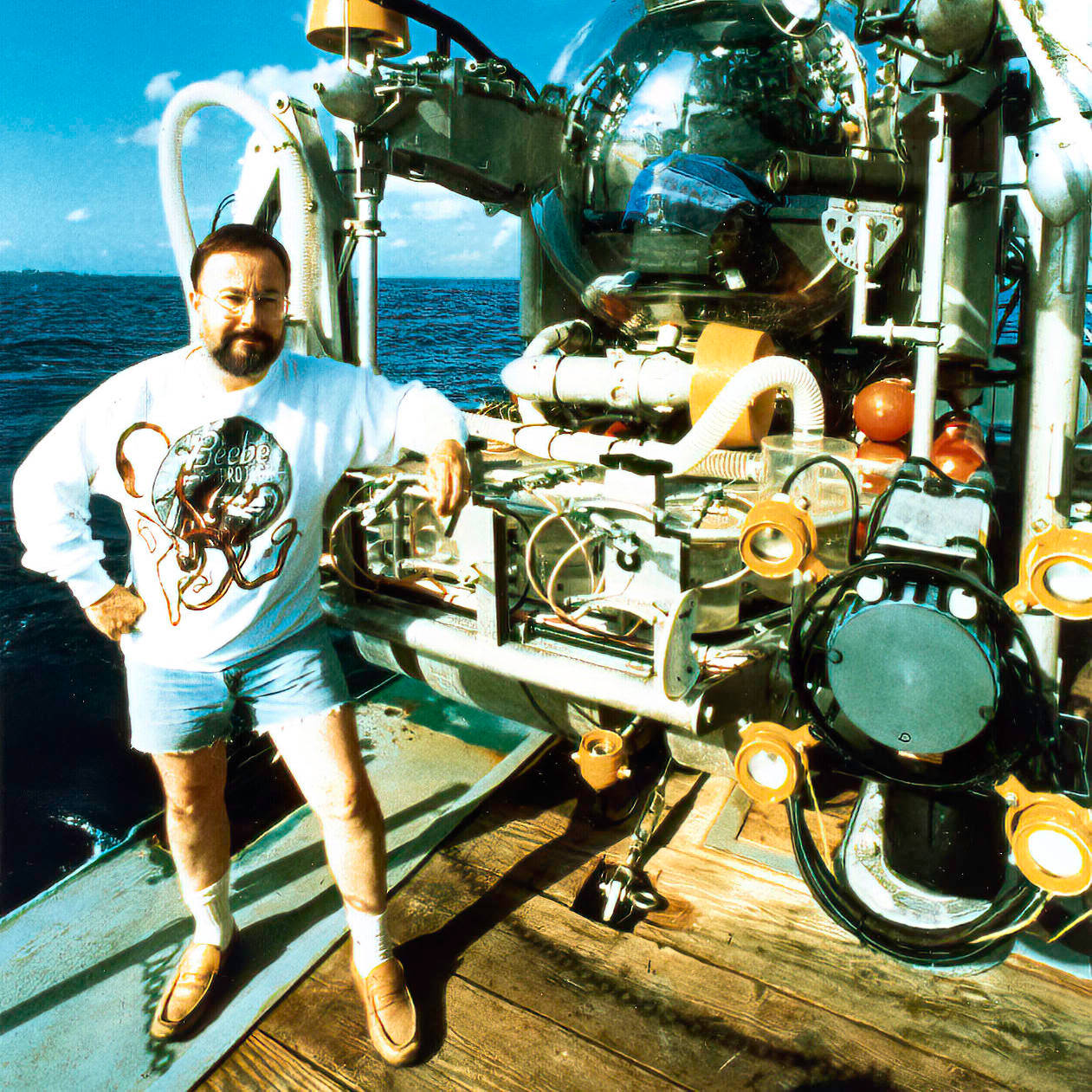
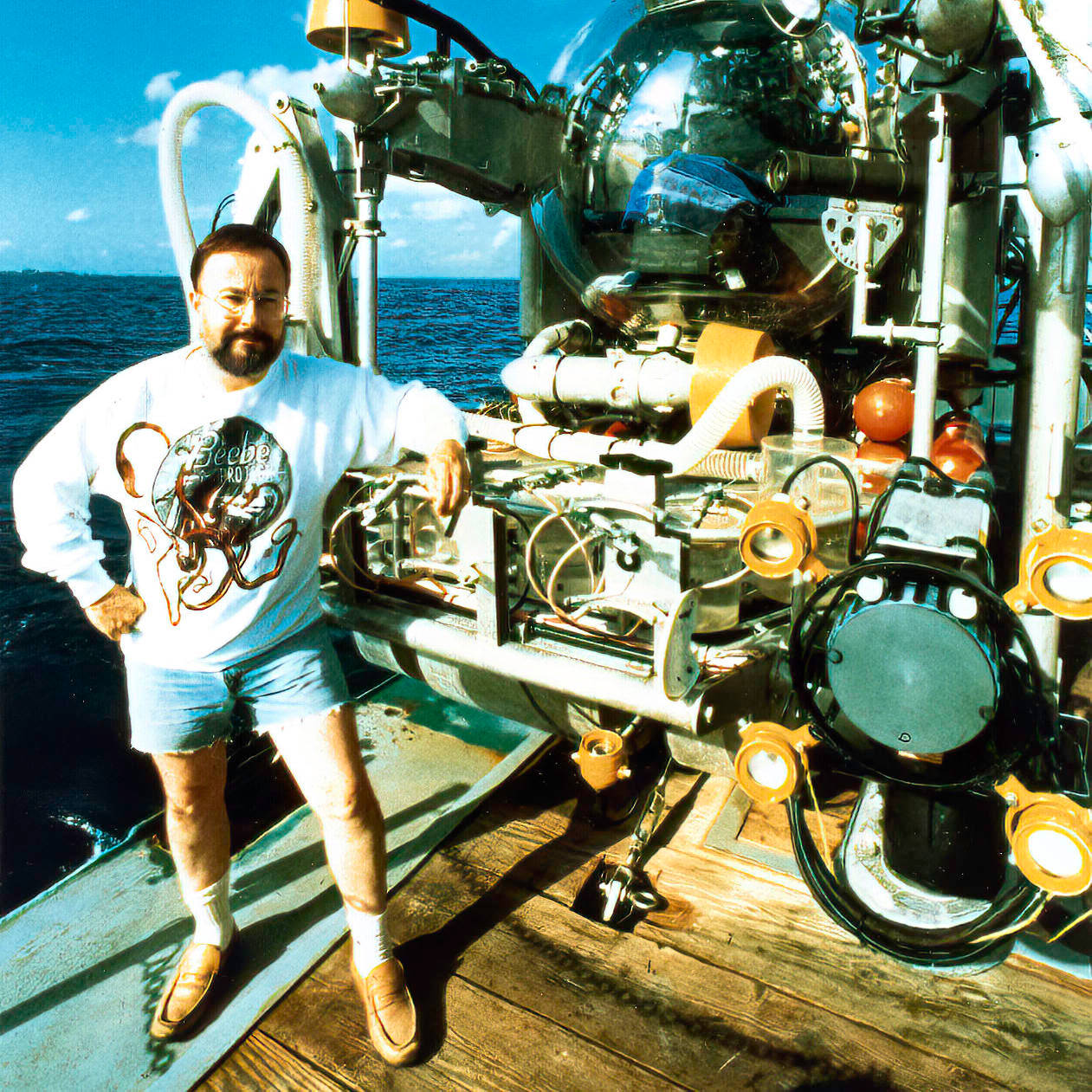
In 1986, Loates was invited to join the Beebe Project expedition off the coast of Bermuda — descending in the Johnson Sea Link and Pisces VI submersibles to depths of one and a half miles, becoming the first
artist in the world to observe and document ocean life from that depth. Organised by National Geographic Society photographer Emory Kristof, and made possible in part through his long-time friend Dr. Joseph MacInnis, the Canadian physician and marine scientist, the expedition opened an entirely new field of subject matter, composition, and colour palette that continues to inform his work.
Throughout his career Loates has worked alongside wildlife conservation authorities across Canada, dedicating sustained time to scientific research as a naturalist as much as an artist.
His work has reached readers in thirteen languages. It has been exhibited at the Royal Ontario Museum, the British Museum, the Alexander Koenig Museum in Bonn, the Centre Culturel de Paris, the Institute of Zoological Research, and the McMichael Canadian Collection. It has appeared in GEO, Reader's Digest, Time, and publications across North America and Europe. Three major volumes document the career: The Art of Glen Loates (1977) — the best-selling collection of any living Canadian artist at the time of publication — Birds of North America (1979), and A Brush with Life (1984). The Royal Canadian Mint renders his imagery on collector coins. He has received commissions from the Audubon Society of America, the National Geographic Society, Equinox, GEO, and the Explorers Club. He continues to produce work for private and corporate collectors worldwide.
The accuracy in Loates' work is not a stylistic choice. It is the product of a practice built entirely on primary sources. He does not work from photographs. He makes as many as forty-five rough pencil sketches of a single animal before committing it to paint. He works from actual bird skins and animal pelts borrowed from the Royal Ontario Museum — the same institution he visited as a boy — to get the specific weight and proportion of each creature exactly right.
He begins every painting from the eye, working outward. The backgrounds are painted last.
The technique itself is entirely his own invention — watercolour, India ink, and Chinese white drawing ink applied with a specially pointed brush, a method devised through years of experimentation to render the precise textures of fur, feather, and muscle that no conventional approach could achieve. It was never taught anywhere. He developed it himself.
In December 1982, Loates flew to Washington carrying his life-size watercolour of a Bald Eagle — seven months in the making, painted to mark the 200th anniversary of the eagle's designation as America's national symbol. In the Oval Office, accompanied by Canadian Ambassador Allan Gotlieb, he presented it personally to President
Ronald Reagan as a gift from the people of Canada to the people of the United States. Reagan called it "a breathtaking representation of America's symbol." When not displayed at the White House, The Bald Eagle is on public view at the Smithsonian Institution. Loates' originals have also been presented to His Royal Highness Prince Philip, Duke of Edinburgh, and to Prime Minister Pierre Elliott Trudeau.
In 1986, Loates was invited to join the Beebe Project expedition off the coast of Bermuda — descending in the Johnson Sea Link and Pisces VI submersibles to depths of one and a half miles, becoming the first
artist in the world to observe and document ocean life from that depth. Organised by National Geographic Society photographer Emory Kristof, and made possible in part through his long-time friend Dr. Joseph MacInnis, the Canadian physician and marine scientist, the expedition opened an entirely new field of subject matter, composition, and colour palette that continues to inform his work.
Throughout his career Loates has worked alongside wildlife conservation authorities across Canada, dedicating sustained time to scientific research as a naturalist as much as an artist.
His work has reached readers in thirteen languages. It has been exhibited at the Royal Ontario Museum, the British Museum, the Alexander Koenig Museum in Bonn, the Centre Culturel de Paris, the Institute of Zoological Research, and the McMichael Canadian Collection. It has appeared in GEO, Reader's Digest, Time, and publications across North America and Europe. Three major volumes document the career: The Art of Glen Loates (1977) — the best-selling collection of any living Canadian artist at the time of publication — Birds of North America (1979), and A Brush with Life (1984). The Royal Canadian Mint renders his imagery on collector coins. He has received commissions from the Audubon Society of America, the National Geographic Society, Equinox, GEO, and the Explorers Club. He continues to produce work for private and corporate collectors worldwide.
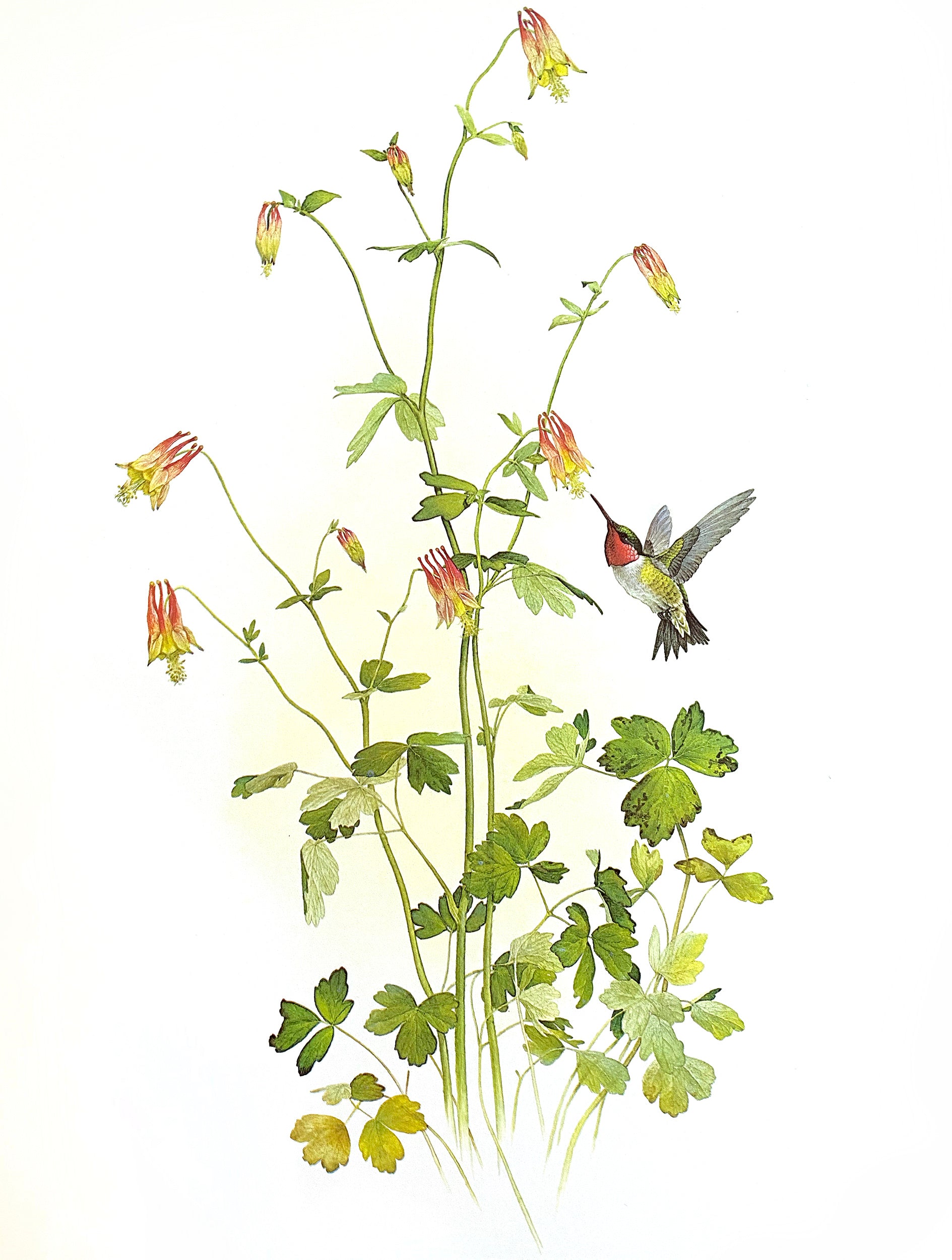
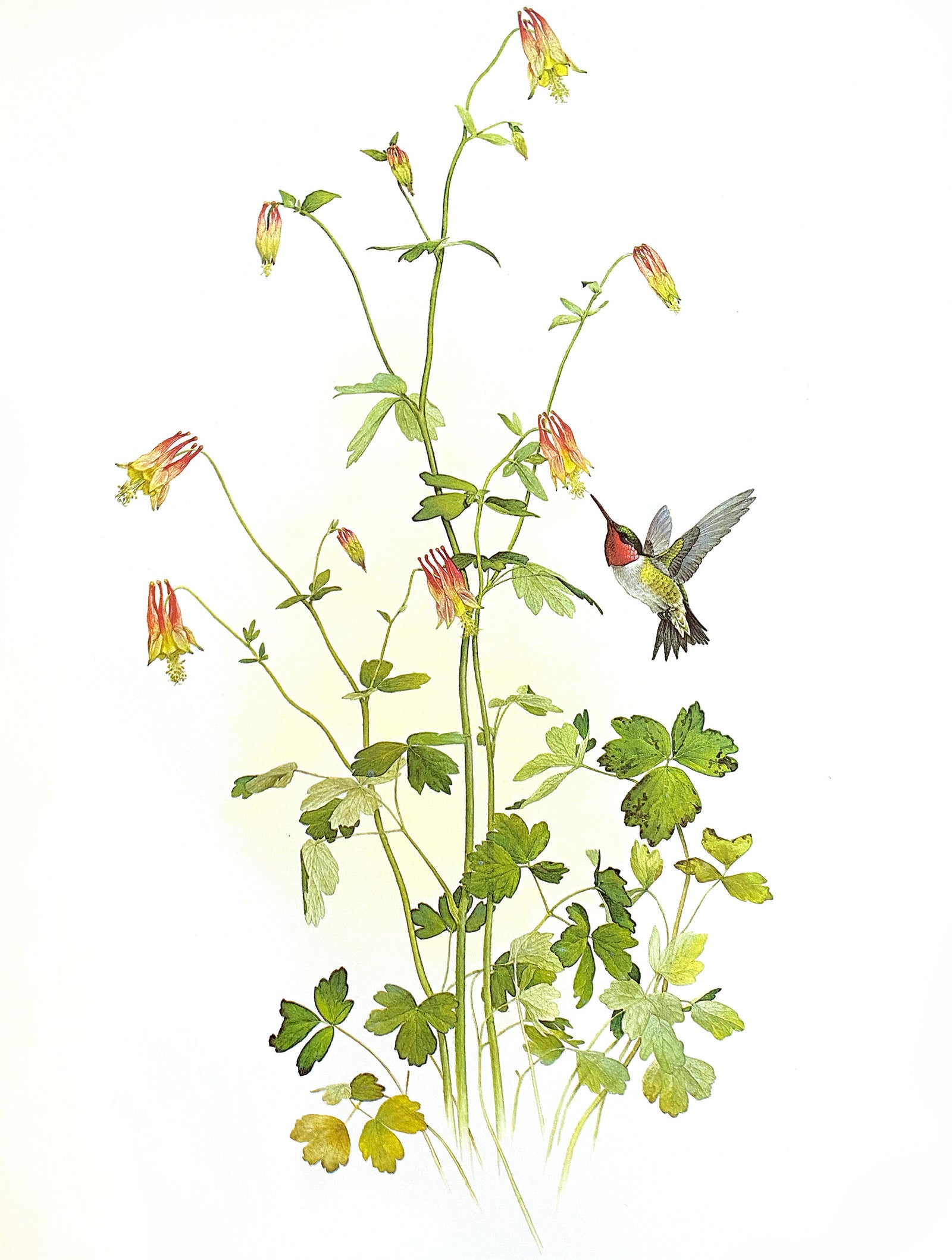
When one refers to the exquisite quality of a piece of art, the usual definition of that over-used adjective comes to mind: beautifully made or designed. Applying that descriptive term to the watercolors of Martin Glen Loates is almost a necessity in order to convey adequately the degree of appreciation that his work arouses. However, the word exquisite itself is derived from the Latin exquisite, chosen, exquisite, from the past participle of exquirere, to search out. It is this shade, then, of the word exquisite that makes the adjective singularly appropriate in a more arcane sense to Loates' work. He has searched out and chosen the subtle gradation in color, the elegant rhythm in form and line, the elusive in mood. His Ruby-throated Hummingbird, as light as the pendant columbine blossoms that attract it, is part of the aura of a summer day, and more: it imparts that clean, verdant, colorful sparkle that characterizes what a summer day is. The artist has managed to illustrate, then to evoke, then to invite, finally to captivate.
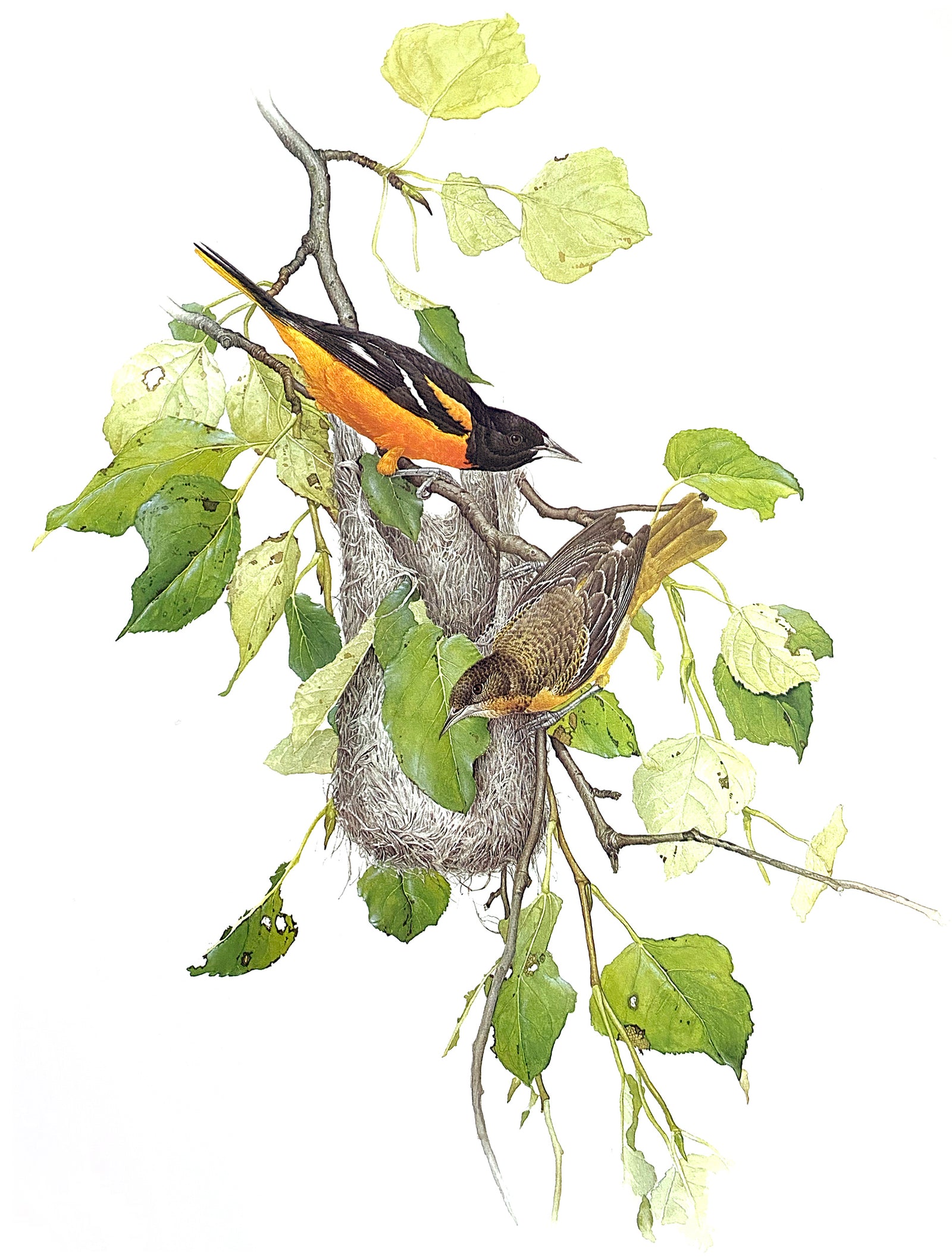
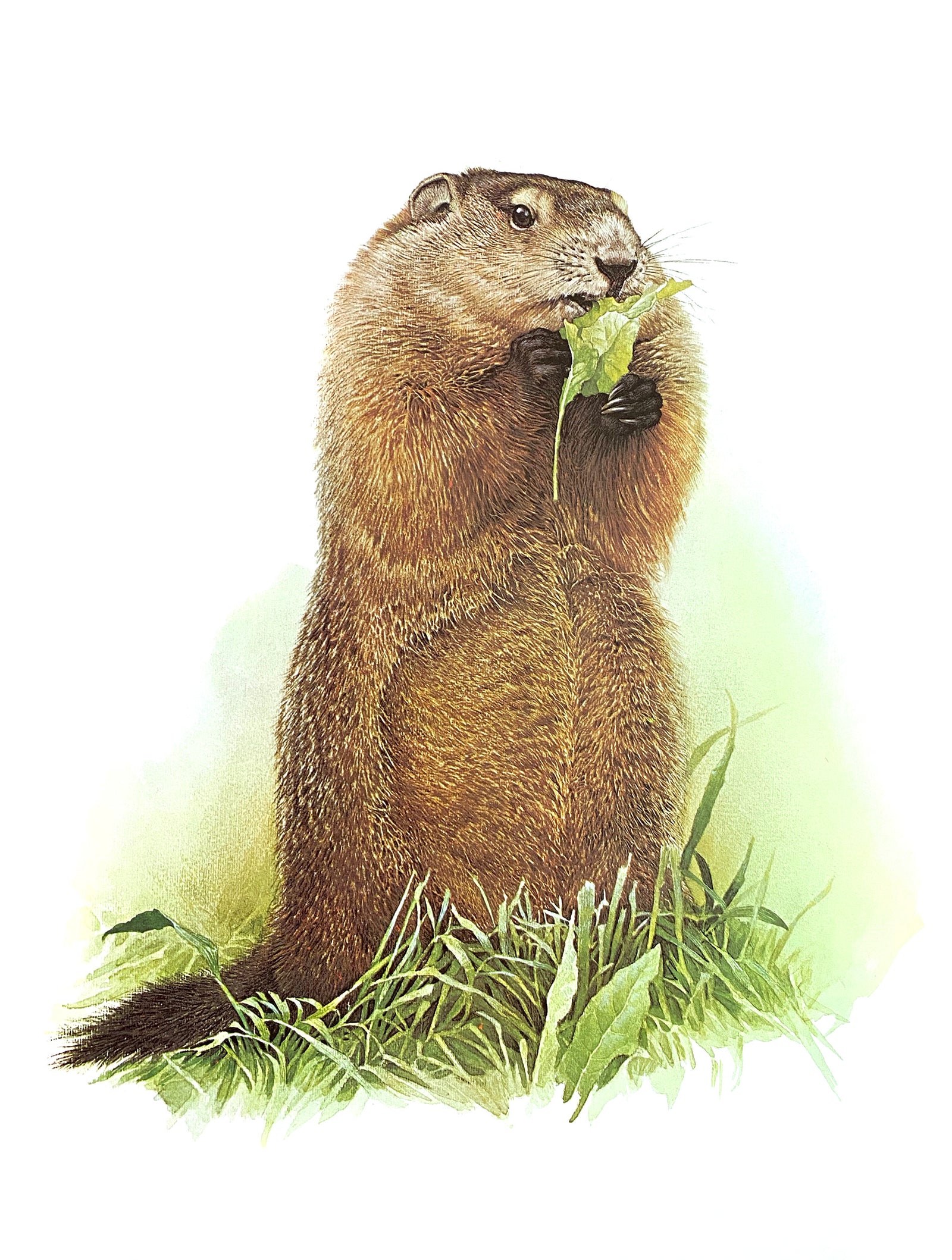
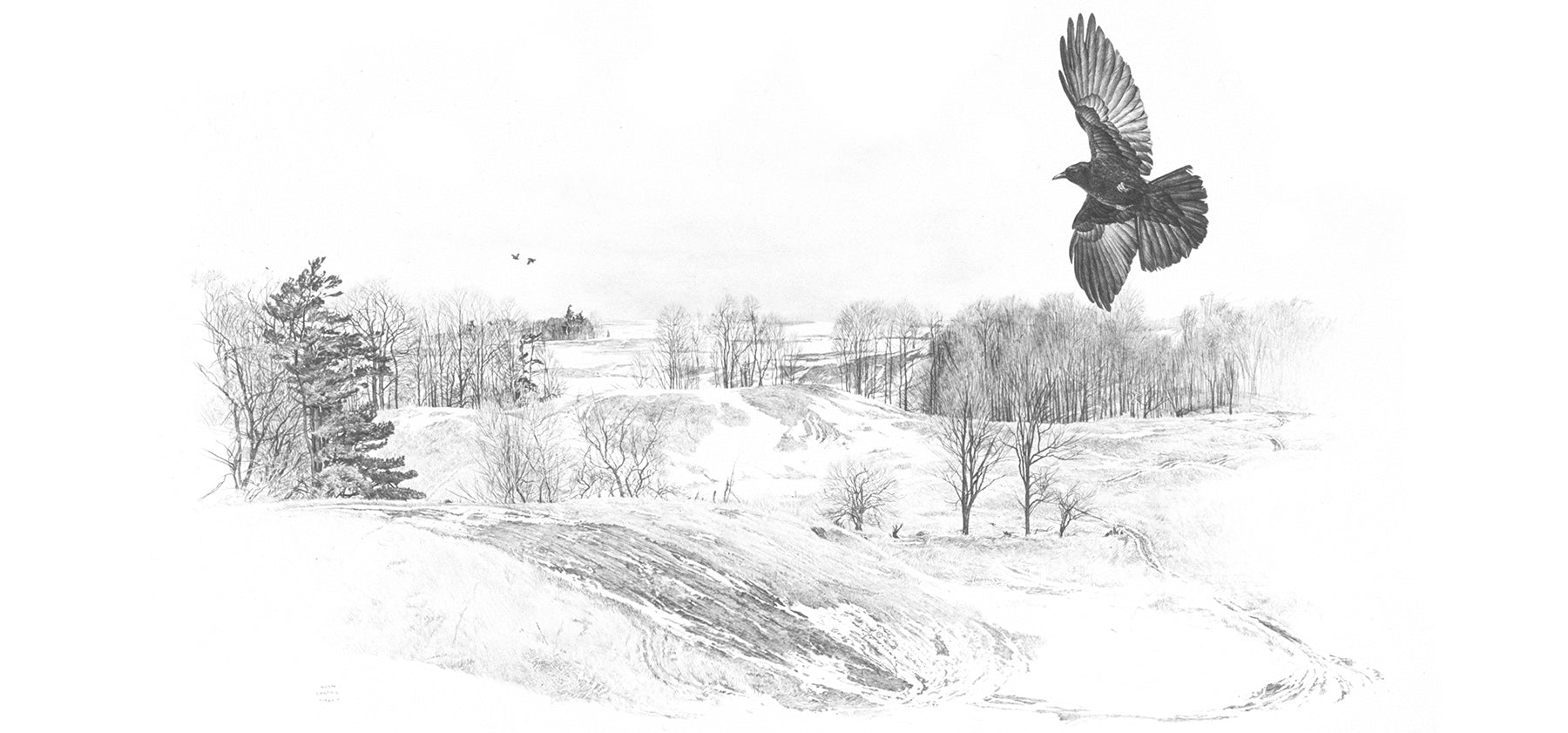
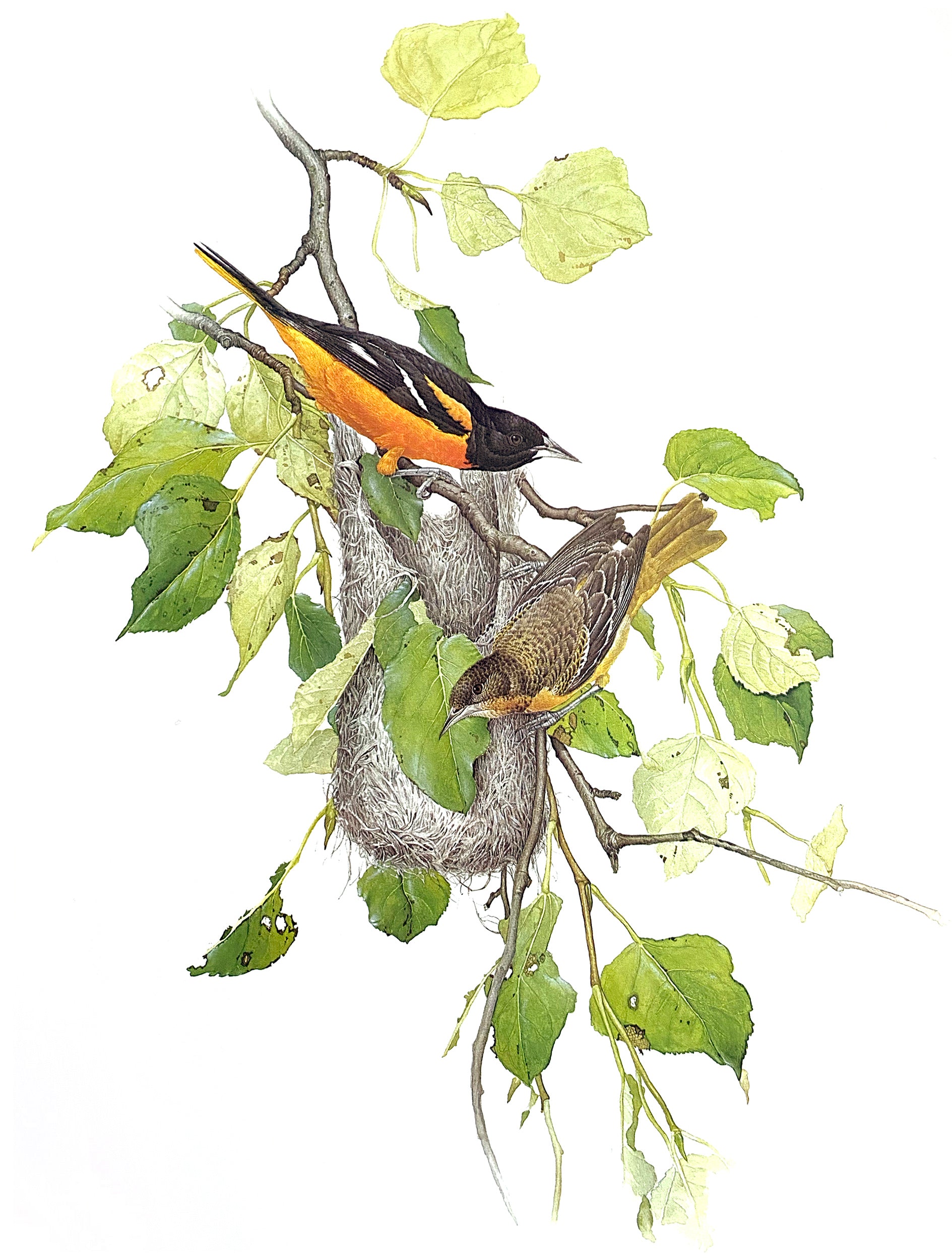
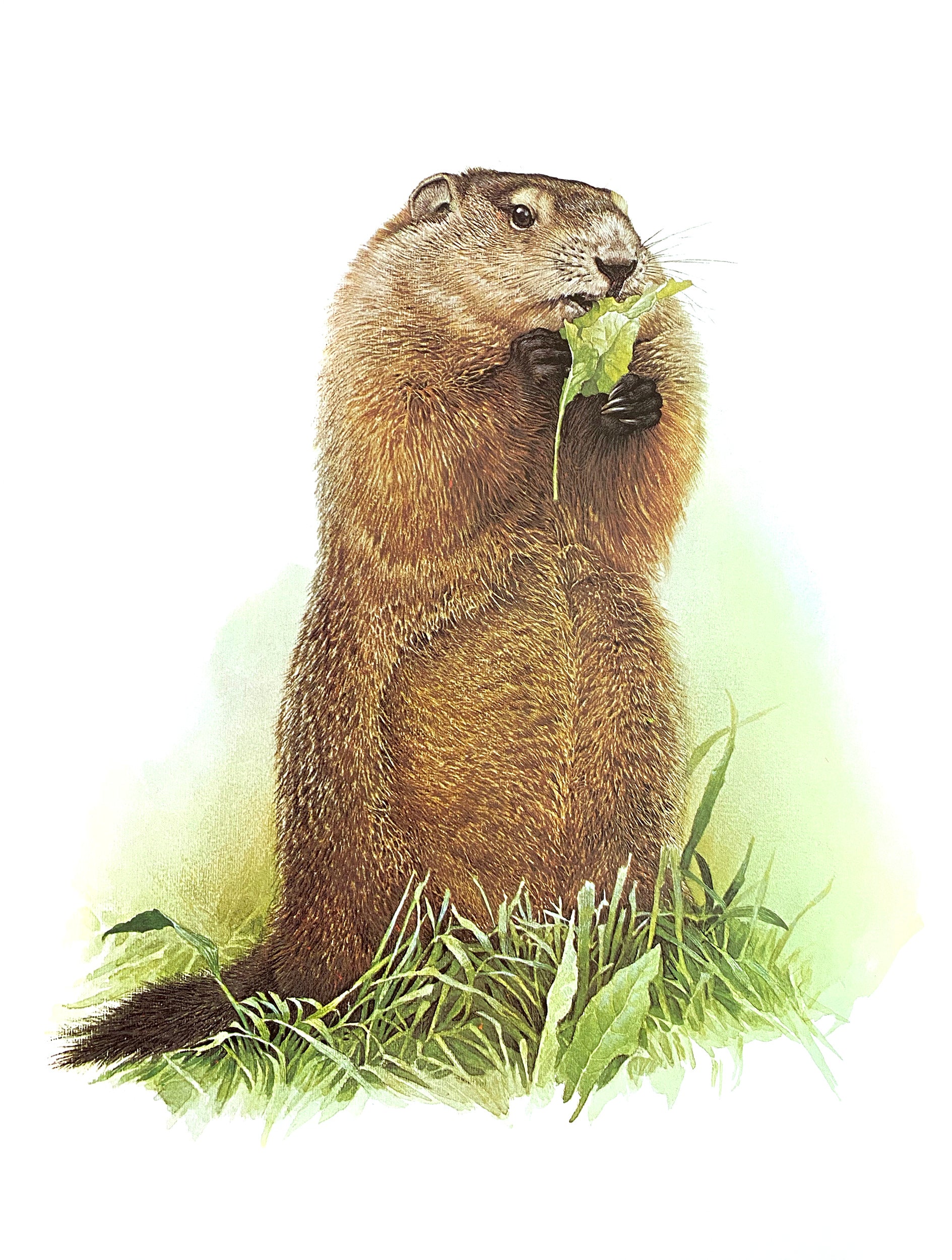
Loates' common woodchuck, perhaps the pièce de résistance of the show, took this reviewer back in time. In childhood, we lay on our stomachs in summer clover, and some cool, green, crushed-grass deliciousness about that delightfully lazy pastime flooded back, immediately, upon seeing this brown, furry fellow standing in the grass, his black front toes clasping a crisp leaf. Many visitors to the exhibit commented on the fur – rich, thick, rendered perfectly, golden brown about the shoulders, greyed out from his whiskered nose, and forming an easily recognizable whorl down the center of the abdomen. Passing a hand down that soft belly, one would enjoy those fine thistle-down patterns of fur. Art, good art, encourages the viewer to imagine tactile possibilities. (The likelihood that the woodchuck would permit such familiarity belongs to another discussion.) Some zoologists have commented that Loates' mammal paintings are among the best they have ever seen. One of the nicest things about his way with mammals, incidentally, is his shrewd ability to avoid the "cute." To do this, one must know the animal very well, paint it accurately, allowing it the dignity of its usual activities, such as standing in a patch of grass eating a leaf, rather than portraying an antic pose that is more beguiling and less characteristic. Loates' pencil drawing of a Ruffed Grouse shows this game bird in his most dramatic moment: his neck feathers raised in a ring about his head, his tail erect like a turkey cock's, his mien admirably commanding and threatening as he mounts his drumming log. Loates uses soft pencil well and proves that black and white can be more colorful than color. The challenge in this medium is to use shadow, light, coarseness, delicacy, and roughness in a kind of orchestration that satisfies so sensually that color would be redundant. In central New York, the Northern (Baltimore) Orioles usually arrive in early May. Glen Loates has painted a pair of these familiar birds, known for their craftsmanship in nest-building. Perched at their pendant nest in the drooping branches of a tree, the pair is caught in the midst of brisk business – nest building. Later, they will browse for their food near the ground and on lush clumps of sweet fern. The underside of the male is bright orange, changing to an ochre color just under the rump. The female wears more subdued colors, her yellowish olive upper parts not so sartorially exciting as the sharp black uppers of her mate. Melodious describes the interplay of colors and tones in this watercolor: Pale, pale green leaves twist to give us deeper green shadows. We rivet upon the vibrant orange of the male, go on to the incredible intricacy of the soft gray nest that occupies the center of the painting, read the female as a more restrained accent in her olive green and dull orange. A caterpillar, later destined to be an oriole's meal, has done a random job on the leaves of this hanging branch. These holes are carefully observed, delineated as painstakingly as the coverts on the birds' wings, and treated as important elements in the total design. The white background of the painting is put to work by the laced leaves, not by accident but by conscious manipulation of negative spaces. Good designers may become great artists; great artists are always good designers. Without going into more detail, Loates' show includes a very small painting of a Snow Goose landing; there is a shadow in the softest shade of gray, cast by its strong neck against the straining pectoral muscles as it comes down to land, which is typical of Loates' meticulous observation and technical proficiency. The effect of the gray shadow is evanescent. It is not easy to use watercolor this way. Other subjects included in the show were a cougar, moose, raccoon, red fox, lynx, meadow vole, mourning cloak and yellow sulphur butterflies, luna moth, swamp iris, and other living things, demonstrating Glen Loates' remarkable versatility.
When one refers to the exquisite quality of a piece of art, the usual definition of that over-used adjective comes to mind: beautifully made or designed. Applying that descriptive term to the watercolors of Martin Glen Loates is almost a necessity in order to convey adequately the degree of appreciation that his work arouses. However, the word exquisite itself is derived from the Latin exquisite, chosen, exquisite, from the past participle of exquirere, to search out. It is this shade, then, of the word exquisite that makes the adjective singularly appropriate in a more arcane sense to Loates' work. He has searched out and chosen the subtle gradation in color, the elegant rhythm in form and line, the elusive in mood. His Ruby-throated Hummingbird, as light as the pendant columbine blossoms that attract it, is part of the aura of a summer day, and more: it imparts that clean, verdant, colorful sparkle that characterizes what a summer day is. The artist has managed to illustrate, then to evoke, then to invite, finally to captivate.
Loates' common woodchuck, perhaps the pièce de résistance of the show, took this reviewer back in time. In childhood, we lay on our stomachs in summer clover, and some cool, green, crushed-grass deliciousness about that delightfully lazy pastime flooded back, immediately, upon seeing this brown, furry fellow standing in the grass, his black front toes clasping a crisp leaf. Many visitors to the exhibit commented on the fur – rich, thick, rendered perfectly, golden brown about the shoulders, greyed out from his whiskered nose, and forming an easily recognizable whorl down the center of the abdomen. Passing a hand down that soft belly, one would enjoy those fine thistle-down patterns of fur. Art, good art, encourages the viewer to imagine tactile possibilities. (The likelihood that the woodchuck would permit such familiarity belongs to another discussion.) Some zoologists have commented that Loates' mammal paintings are among the best they have ever seen. One of the nicest things about his way with mammals, incidentally, is his shrewd ability to avoid the "cute." To do this, one must know the animal very well, paint it accurately, allowing it the dignity of its usual activities, such as standing in a patch of grass eating a leaf, rather than portraying an antic pose that is more beguiling and less characteristic. Loates' pencil drawing of a Ruffed Grouse shows this game bird in his most dramatic moment: his neck feathers raised in a ring about his head, his tail erect like a turkey cock's, his mien admirably commanding and threatening as he mounts his drumming log. Loates uses soft pencil well and proves that black and white can be more colorful than color. The challenge in this medium is to use shadow, light, coarseness, delicacy, and roughness in a kind of orchestration that satisfies so sensually that color would be redundant. In central New York, the Northern (Baltimore) Orioles usually arrive in early May. Glen Loates has painted a pair of these familiar birds, known for their craftsmanship in nest-building. Perched at their pendant nest in the drooping branches of a tree, the pair is caught in the midst of brisk business – nest building. Later, they will browse for their food near the ground and on lush clumps of sweet fern. The underside of the male is bright orange, changing to an ochre color just under the rump. The female wears more subdued colors, her yellowish olive upper parts not so sartorially exciting as the sharp black uppers of her mate. Melodious describes the interplay of colors and tones in this watercolor: Pale, pale green leaves twist to give us deeper green shadows. We rivet upon the vibrant orange of the male, go on to the incredible intricacy of the soft gray nest that occupies the center of the painting, read the female as a more restrained accent in her olive green and dull orange. A caterpillar, later destined to be an oriole's meal, has done a random job on the leaves of this hanging branch. These holes are carefully observed, delineated as painstakingly as the coverts on the birds' wings, and treated as important elements in the total design. The white background of the painting is put to work by the laced leaves, not by accident but by conscious manipulation of negative spaces. Good designers may become great artists; great artists are always good designers. Without going into more detail, Loates' show includes a very small painting of a Snow Goose landing; there is a shadow in the softest shade of gray, cast by its strong neck against the straining pectoral muscles as it comes down to land, which is typical of Loates' meticulous observation and technical proficiency. The effect of the gray shadow is evanescent. It is not easy to use watercolor this way. Other subjects included in the show were a cougar, moose, raccoon, red fox, lynx, meadow vole, mourning cloak and yellow sulphur butterflies, luna moth, swamp iris, and other living things, demonstrating Glen Loates' remarkable versatility.
Maclean's magazine once called Loates "Nature's sternest painter." Les Line, then editor of Audubon Magazine — the most authoritative voice in North American wildlife art — wrote: "There is none better in this elite category than Martin Glen Loates. The name of Martin Glen Loates is not as famous as it deserves to be."
And yet some early critics found his work too precise, too faithful to the specimen — more suited, they suggested, to a field guide than a gallery wall.
Loates addressed this directly in his own artist's statement, and his answer was unambiguous: "Animal paintings should not be considered merely illustrations or studies; rather, they are truly creations of art."
He was not alone in making this argument. The great masters of the Renaissance were driven by the same conviction — that to truly see a living thing, you must first truly understand it. Leonardo dissected the human form not as a scientist but as a painter. Dürer rendered a rhinoceros from a written description with such fidelity that his woodcut remained the definitive European image of the animal for two centuries. The precision was never the limitation. It was the discipline from which everything else followed.
What Loates brought to wildlife art was not simply accuracy but a complete integration of scientific knowledge and artistic vision. As he wrote: "The layman
should be able to look at a good animal painting and feel surprised and excited, be convinced of its anatomical structure, and be able to gain a familiarity with its habitat, as well as a love for the subject itself."
The critics who found his work too accurate for art had it exactly backwards. The question has largely answered itself.
Maclean's magazine once called Loates "Nature's sternest painter." Les Line, then editor of Audubon Magazine — the most authoritative voice in North American wildlife art — wrote: "There is none better in this elite category than Martin Glen Loates. The name of Martin Glen Loates is not as famous as it deserves to be."
And yet some early critics found his work too precise, too faithful to the specimen — more suited, they suggested, to a field guide than a gallery wall.
Loates addressed this directly in his own artist's statement, and his answer was unambiguous: "Animal paintings should not be considered merely illustrations or studies; rather, they are truly creations of art."
He was not alone in making this argument. The great masters of the Renaissance were driven by the same conviction — that to truly see a living thing, you must first truly understand it. Leonardo dissected the human form not as a scientist but as a painter. Dürer rendered a rhinoceros from a written description with such fidelity that his woodcut remained the definitive European image of the animal for two centuries. The precision was never the limitation. It was the discipline from which everything else followed.
What Loates brought to wildlife art was not simply accuracy but a complete integration of scientific knowledge and artistic vision. As he wrote: "The layman
should be able to look at a good animal painting and feel surprised and excited, be convinced of its anatomical structure, and be able to gain a familiarity with its habitat, as well as a love for the subject itself."
The critics who found his work too accurate for art had it exactly backwards. The question has largely answered itself.
My father is in his eighties now. I think about what that means for the work more than I used to.
There is a comparison I keep returning to — the great Japanese swordsmiths, the master craftsmen of the samurai tradition, who brought to the forging of steel the same patience and precision that my father brings to a brush. It is a dying art in the most literal sense: when the master is gone, what they knew goes with them. Not because the techniques cannot be written down, but because the techniques were never the point. The point was the accumulated attention of a lifetime — the decades of looking before a single mark was made, and the decades more of making marks until the hand and the eye became the same thing.
Glen's work cannot be meaningfully imitated. This is not a boast — it is an observable fact. Every feather in every bird is individually placed. Every strand of fur is individually rendered. Where other artists — skilled artists — will suggest a difficult passage with a thick brush, or dissolve a complex form into atmospheric mist, or hide what they don't want to paint behind a conveniently placed branch, my father paints what is there. He has always painted what is there. The difficulty is not a technique. It is a character trait.
As Maclean's observed, he paints with the patience of St. Francis and the persistence of a bloodhound. He has been known to spend three days with meat tossed to a lynx just to study the facial contortions of an animal at the moment of a strike. He paints what he sees, not what is convenient to see.
When Glen is gone, this is it. There will be no more. What exists is what exists — and it was made by a man who never took a shortcut in his life.
~ Michael Loates
The Glen Loates Gallery
My father is in his eighties now. I think about what that means for the work more than I used to.
There is a comparison I keep returning to — the great Japanese swordsmiths, the master craftsmen of the samurai tradition, who brought to the forging of steel the same patience and precision that my father brings to a brush. It is a dying art in the most literal sense: when the master is gone, what they knew goes with them. Not because the techniques cannot be written down, but because the techniques were never the point. The point was the accumulated attention of a lifetime — the decades of looking before a single mark was made, and the decades more of making marks until the hand and the eye became the same thing.
Glen's work cannot be meaningfully imitated. This is not a boast — it is an observable fact. Every feather in every bird is individually placed. Every strand of fur is individually rendered. Where other artists — skilled artists — will suggest a difficult passage with a thick brush, or dissolve a complex form into atmospheric mist, or hide what they don't want to paint behind a conveniently placed branch, my father paints what is there. He has always painted what is there. The difficulty is not a technique. It is a character trait.
As Maclean's observed, he paints with the patience of St. Francis and the persistence of a bloodhound. He has been known to spend three days with meat tossed to a lynx just to study the facial contortions of an animal at the moment of a strike. He paints what he sees, not what is convenient to see.
When Glen is gone, this is it. There will be no more. What exists is what exists — and it was made by a man who never took a shortcut in his life.
~ Michael Loates
The Glen Loates Gallery
Loates' work appears at auction from time to time — pieces from private collections, estates, inheritances. We watch these sales closely. What we see, consistently, is significant work selling for a fraction of its value — not because the buyers lack resources, but because they lack context. They are looking at a wildlife painting. They don't know they are looking at one of the most significant bodies of work in the history of Canadian art, made by an artist whose technique cannot be replicated and whose career cannot be extended.
Auction houses are not equipped to tell that story. Their cataloguers are generalists. The lots move quickly. The provenance is noted but the significance is not explained. And so work that deserves to be understood as a serious acquisition is treated as decorative, and priced accordingly.
This gallery exists, in part, to change that. Every page here is an attempt to give you the context that an auction catalogue never will — to show you not just what a piece looks like, but what it took to make it, what it means in the arc of a remarkable career, and why it will not be made again.
An educated collector is not just a better customer. They are a better steward of the work. That is what we are here to build.
If you have encountered Loates' work at auction or through an estate and want to understand what you are looking at, we are here for that conversation.
~ Michael Loates
The Glen Loates Gallery
Loates' work appears at auction from time to time — pieces from private collections, estates, inheritances. We watch these sales closely. What we see, consistently, is significant work selling for a fraction of its value — not because the buyers lack resources, but because they lack context. They are looking at a wildlife painting. They don't know they are looking at one of the most significant bodies of work in the history of Canadian art, made by an artist whose technique cannot be replicated and whose career cannot be extended.
Auction houses are not equipped to tell that story. Their cataloguers are generalists. The lots move quickly. The provenance is noted but the significance is not explained. And so work that deserves to be understood as a serious acquisition is treated as decorative, and priced accordingly.
This gallery exists, in part, to change that. Every page here is an attempt to give you the context that an auction catalogue never will — to show you not just what a piece looks like, but what it took to make it, what it means in the arc of a remarkable career, and why it will not be made again.
An educated collector is not just a better customer. They are a better steward of the work. That is what we are here to build.
If you have encountered Loates' work at auction or through an estate and want to understand what you are looking at, we are here for that conversation.
~ Michael Loates
The Glen Loates Gallery
The Glen Loates Gallery is the official and definitive source for the work of Glen Loates R.C.A. — operated by his son Michael, who oversees the collection personally and ensures that every piece meets the archival standards Loates' work has always demanded.
Every piece here is produced to museum standards: archival materials, fade-resistant inks, gallery-quality framing. Delivered worldwide. Every acquisition backed by our complete satisfaction guarantee.
You can buy wildlife art anywhere. You can only own a Glen Loates here.
——
"If I can share with the viewer some of the enjoyment of my own experience with nature,
I feel I will have accomplished more than I could have hoped for."
~ Glen Loates R.C.A.
The Glen Loates Gallery is the official and definitive source for the work of Glen Loates R.C.A. — operated by his son Michael, who oversees the collection personally and ensures that every piece meets the archival standards Loates' work has always demanded.
Every piece here is produced to museum standards: archival materials, fade-resistant inks, gallery-quality framing. Delivered worldwide. Every acquisition backed by our complete satisfaction guarantee.
You can buy wildlife art anywhere. You can only own a Glen Loates here.
——
"If I can share with the viewer some of the enjoyment of my own experience with nature,
I feel I will have accomplished more than I could have hoped for."
~ Glen Loates R.C.A.


A Ruby-throated Hummingbird hovering at a Red Columbine — the bird frozen mid-hover, the gorget iridescent, the bill aligned with the long spur of the columbine flower. This is the perfect mutualism made visible: the columbine evolved its long red spur specifically for the long bill of the hummingbird, and the hummingbird evolved its hovering flight specifically for this kind of feeding. Glen painted the relationship as precisely as its biology.
The Red Columbine — Aquilegia canadensis — is rendered with the same botanical precision Glen brought to all his wildflower subjects: the pendant flowers, the distinctive spur, the compound leaves. Glen Loates is a member of the Royal Canadian Academy of Arts; his bird-and-botanical compositions demonstrate the dual naturalist and artistic discipline that defines his practice.
Produced as a museum-quality giclée on archival, acid-free paper using fade-resistant inks. A 1" white border surrounds the image, ready for the framer of your choice.