-
-
-
Connexion




Listen to Michael's note · 14 min

People still write to ask what became of Glen Loates. Did he stop painting? Did he pass away? For years there was no answer anywhere, and the silence filled itself in. This page is that answer, and it is the reason this gallery exists.
My father is in his eighties now. I think about what that means for the work more than I used to.
There is a comparison I keep returning to: the great Japanese swordsmiths, the master craftsmen of the samurai tradition, who brought to the forging of steel the same patience and precision my father brings to a brush. Theirs is a discipline that does not transmit. Not because the techniques cannot be written down, but because the techniques were never the point. The point was the accumulated attention of a lifetime, the decades of looking before a single mark was made, and the decades more of making marks until the hand and the eye became the same thing.
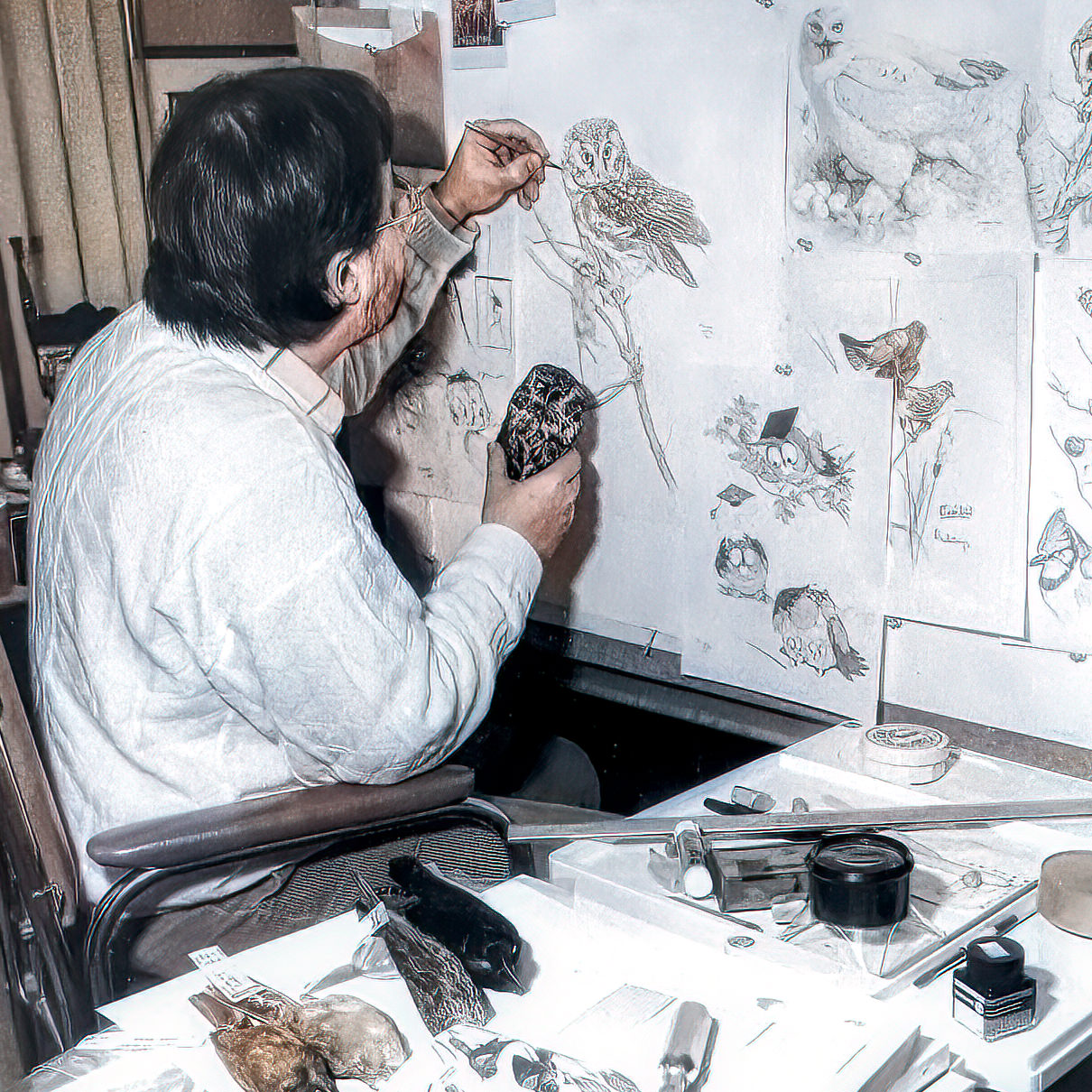
Glen's work cannot be meaningfully imitated. That is not a boast, it is an observable fact. Every feather in every bird is individually placed. Every strand of fur is individually rendered. Where other skilled artists will suggest a difficult passage with a broad brush, dissolve a complex form into atmospheric mist, or hide what they would rather not paint behind a conveniently placed branch, my father paints what is there. He always has. The difficulty is not a technique. It is a character trait.
As Maclean's put it, he paints with the patience of St. Francis and the persistence of a bloodhound. He once spent three days tossing meat to a lynx just to study the face of an animal at the moment of a strike, and he would make as many as forty-five sketches before beginning a major painting. He paints what he sees, not what is convenient to see.
People still write to ask what became of Glen Loates. Did he stop painting? Did he pass away? For years there was no answer anywhere, and the silence filled itself in. This page is that answer, and it is the reason this gallery exists.
My father is in his eighties now. I think about what that means for the work more than I used to.
There is a comparison I keep returning to: the great Japanese swordsmiths, the master craftsmen of the samurai tradition, who brought to the forging of steel the same patience and precision my father brings to a brush. Theirs is a discipline that does not transmit. Not because the techniques cannot be written down, but because the techniques were never the point. The point was the accumulated attention of a lifetime, the decades of looking before a single mark was made, and the decades more of making marks until the hand and the eye became the same thing.
Glen's work cannot be meaningfully imitated. That is not a boast, it is an observable fact. Every feather in every bird is individually placed. Every strand of fur is individually rendered. Where other skilled artists will suggest a difficult passage with a broad brush, dissolve a complex form into atmospheric mist, or hide what they would rather not paint behind a conveniently placed branch, my father paints what is there. He always has. The difficulty is not a technique. It is a character trait.
As Maclean's put it, he paints with the patience of St. Francis and the persistence of a bloodhound. He once spent three days tossing meat to a lynx just to study the face of an animal at the moment of a strike, and he would make as many as forty-five sketches before beginning a major painting. He paints what he sees, not what is convenient to see.
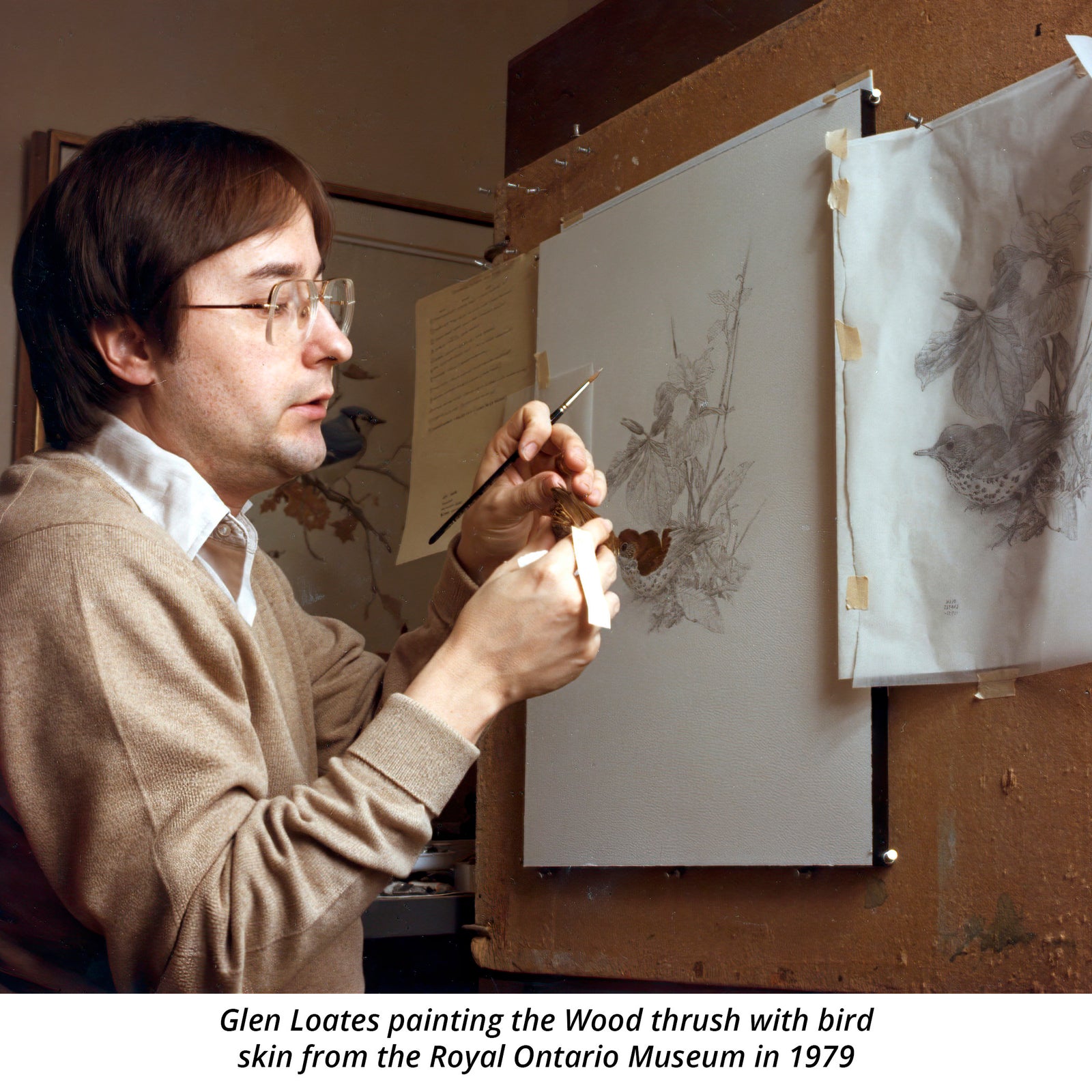
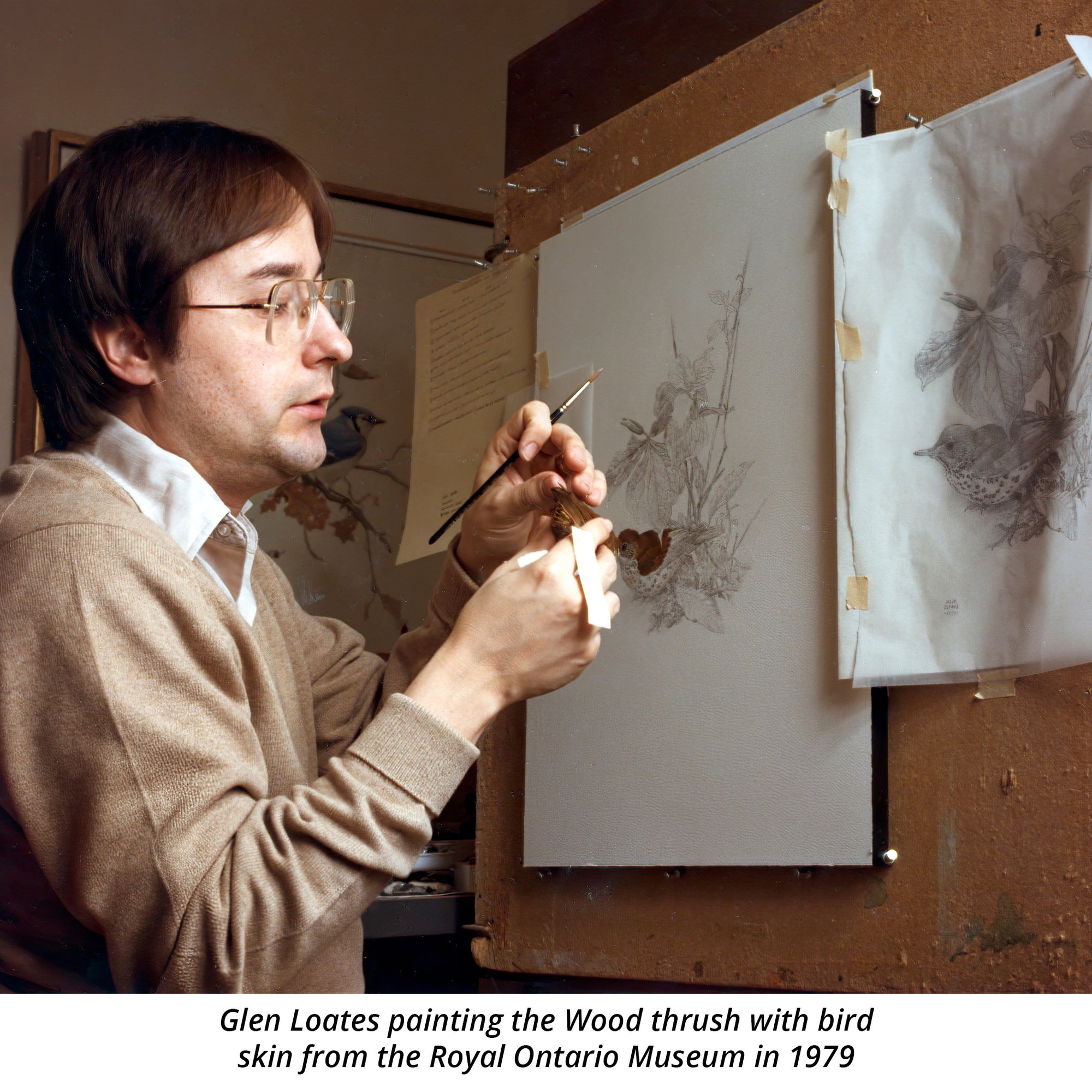
He did all of it without a formal education in art. He left school in Grade 9, and the Ontario College of Art turned him away, citing insufficient academic credits and noting that it had little to offer someone so devoted to wildlife painting. So he taught himself at the Royal Ontario Museum, from study skins laid out under the lamp, and from live birds at the feeder.
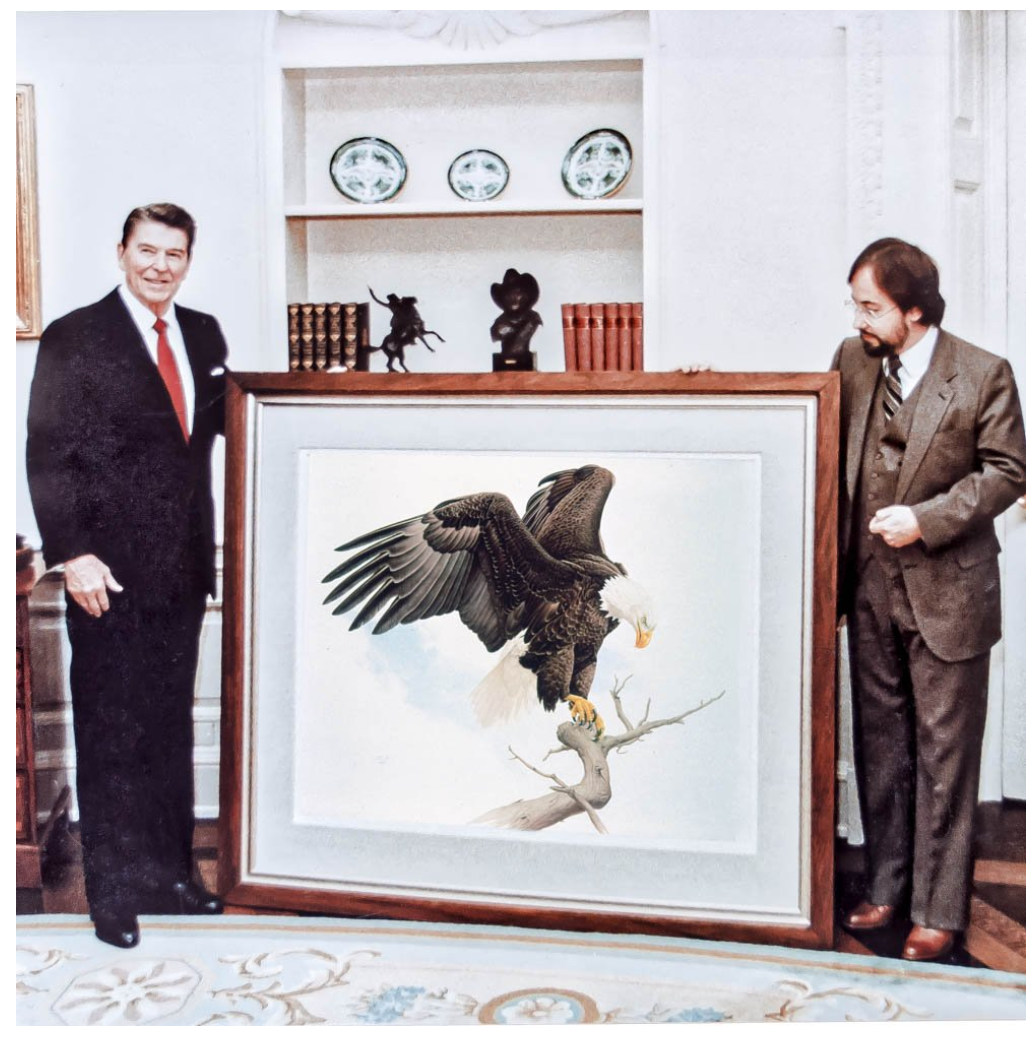
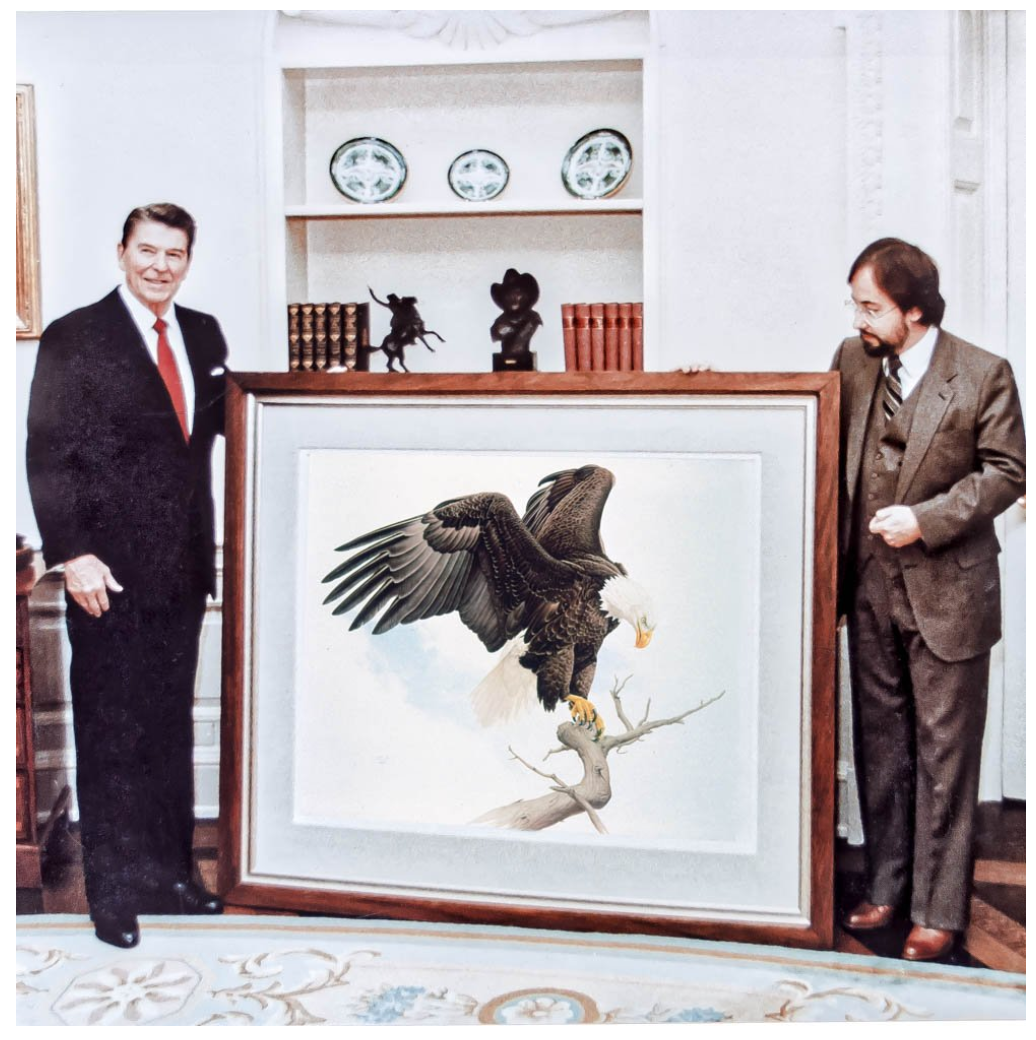
The world noticed. In 1968 Canada issued his Gray Jay as a postage stamp, 24.3 million copies, the first Canadian stamp produced in four-colour lithography. In 1971 the McMichael Canadian Collection gave him a one-man exhibition, the first it had ever granted a wildlife painter, and more than one hundred thousand people came to see it. In 1974 he became the first wildlife painter elected to full membership in the Royal Canadian Academy of Arts, and Cornell University's Laboratory of Ornithology invited him to show more than forty watercolours at Sapsucker Woods, where Fuertes, Sir Peter Scott and Roger Tory Peterson had shown before him. His brother Bernard published The Art of Glen Loates, a book that set a new standard for art publishing in Canada. In 1982 he presented The Bald Eagle to President Reagan in the Oval Office.
That is what I mean when I call him a pioneer of Canadian wildlife art.
He did all of it without a formal education in art. He left school in Grade 9, and the Ontario College of Art turned him away, citing insufficient academic credits and noting that it had little to offer someone so devoted to wildlife painting. So he taught himself at the Royal Ontario Museum, from study skins laid out under the lamp, and from live birds at the feeder.
The world noticed. In 1968 Canada issued his Gray Jay as a postage stamp, 24.3 million copies, the first Canadian stamp produced in four-colour lithography. In 1971 the McMichael Canadian Collection gave him a one-man exhibition, the first it had ever granted a wildlife painter, and more than one hundred thousand people came to see it. In 1974 he became the first wildlife painter elected to full membership in the Royal Canadian Academy of Arts, and Cornell University's Laboratory of Ornithology invited him to show more than forty watercolours at Sapsucker Woods, where Fuertes, Sir Peter Scott and Roger Tory Peterson had shown before him. His brother Bernard published The Art of Glen Loates, a book that set a new standard for art publishing in Canada. In 1982 he presented The Bald Eagle to President Reagan in the Oval Office.
That is what I mean when I call him a pioneer of Canadian wildlife art.
The answer is simpler than the rumours, and harder. He had always gone into the wilderness to study his subjects where they lived, on expeditions throughout Canada and on drawing trips with A.J. Casson of the Group of Seven. Even before the falls, a hip injury had begun to limit those long journeys.
Then, one holiday season, on the way to my grandparents' townhouse in Thornhill, my father slipped on black ice just outside their door and broke his leg. It took reconstructive surgery, metal rods and screws, and a long recovery, and he has walked with a cane ever since.
Some years later, as he was working his way back to the painter he had been before the accident, he headed down to his studio to continue a piece he had been working on, slipped on a wet wood floor, and broke the same leg again. I was in Grade 9, just in from the school bus, when I heard him cry out. I called my mother, who left her classroom and drove home, and the fire department and ambulance crew carried him out. It meant a second reconstruction, and another long road back.
Both recoveries meant months on strong painkillers. Anyone who has watched someone they love come off medication like that knows the healing does not end when the bones do.
Those were the years the art world moved online. Artists built followings on social media while my father was learning to walk again, and many people who had grown up with his work simply lost track of him.
He is still here, and he still draws. He works at his own pace now, and everything here was made by someone who never took a shortcut in his life. This gallery exists so that the people who knew his work can finally hear where he has been, and so that people meeting it for the first time, young or old, can see what he made. What is old becomes new again. Bringing it to them is the job I have taken on.
The answer is simpler than the rumours, and harder. He had always gone into the wilderness to study his subjects where they lived, on expeditions throughout Canada and on drawing trips with A.J. Casson of the Group of Seven. Even before the falls, a hip injury had begun to limit those long journeys.
Then, one holiday season, on the way to my grandparents' townhouse in Thornhill, my father slipped on black ice just outside their door and broke his leg. It took reconstructive surgery, metal rods and screws, and a long recovery, and he has walked with a cane ever since.
Some years later, as he was working his way back to the painter he had been before the accident, he headed down to his studio to continue a piece he had been working on, slipped on a wet wood floor, and broke the same leg again. I was in Grade 9, just in from the school bus, when I heard him cry out. I called my mother, who left her classroom and drove home, and the fire department and ambulance crew carried him out. It meant a second reconstruction, and another long road back.
Both recoveries meant months on strong painkillers. Anyone who has watched someone they love come off medication like that knows the healing does not end when the bones do.
Those were the years the art world moved online. Artists built followings on social media while my father was learning to walk again, and many people who had grown up with his work simply lost track of him.
He is still here, and he still draws. He works at his own pace now, and everything here was made by someone who never took a shortcut in his life. This gallery exists so that the people who knew his work can finally hear where he has been, and so that people meeting it for the first time, young or old, can see what he made. What is old becomes new again. Bringing it to them is the job I have taken on.
There is a photograph of me in a book my father gave me. I am small, standing at his elbow in the studio, holding a sheet of pencil studies while he works. The caption beneath it, in calligraphy, reads: The work progressed with a little assistance from my son Michael.
The book documents the Siberian Tiger. Electrolux commissioned my father to paint the Siberian tiger that had been the company's emblem for more than twenty years, life size, on a stretched canvas 5.75 feet by 7 feet. Before the final pose was chosen he made well over forty preliminary sketches and seven detailed drawings of Bengal and Siberian tigers, then spent four weeks on the life-size pencil drawing alone.
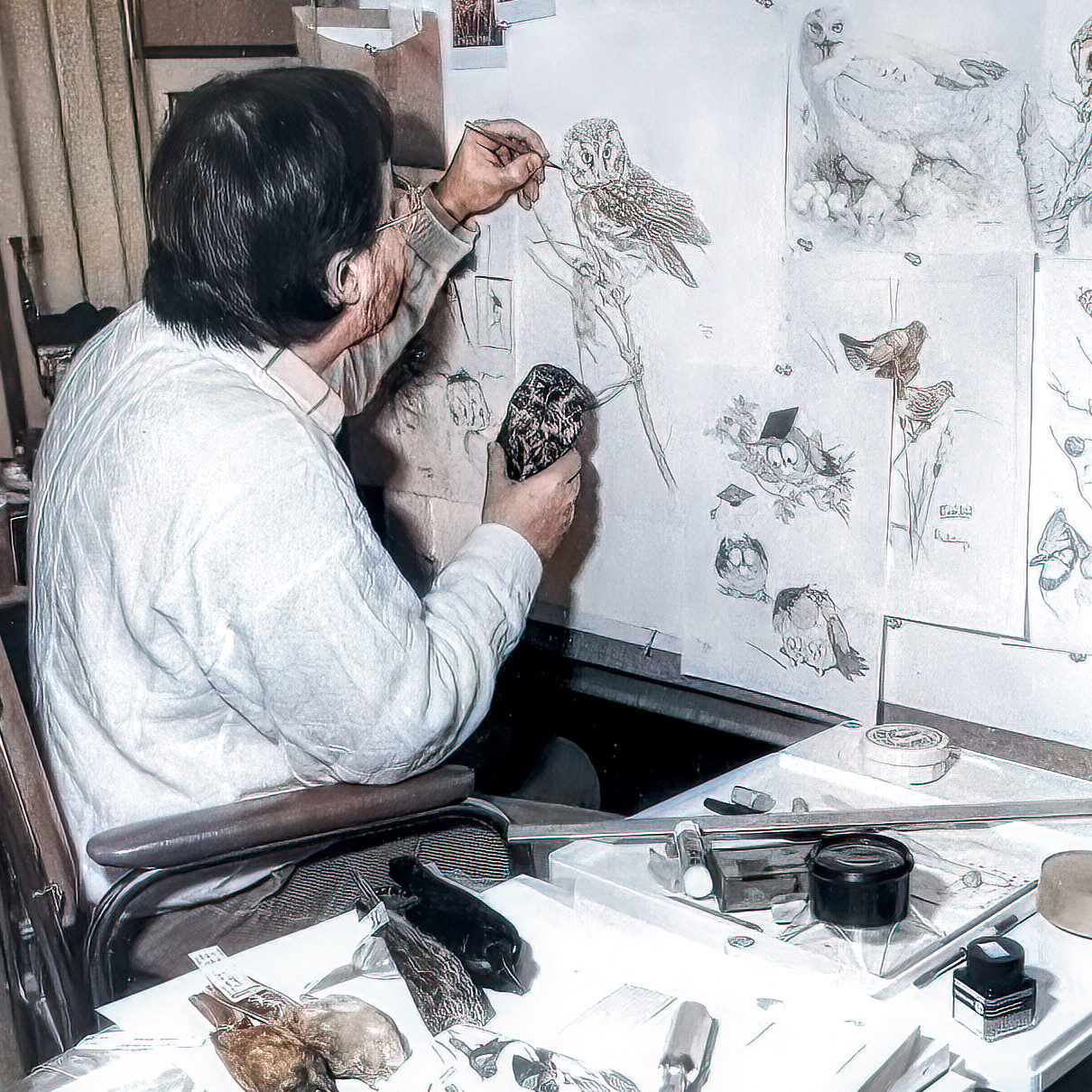
The Royal Ontario Museum loaned him a Siberian tiger skin, and it stayed in the studio for the length of the work. He would hold the pelt in his hands, running his fingers through the fur to see how it behaved and how the light caught it from different angles, studying its colour and its texture. He draped it over a chair, laid it on the floor, and sometimes studied it under a large magnifying glass for the finest details. He made frequent visits to the tigers at the zoo, filling pages of colour notes, and he painted the eyes first, for the hypnotic expression he had watched there.
It is a watercolour, painted on gessoed canvas. He tested several canvases before choosing one, worked from light to dark as he would on paper, and let the white of the canvas carry the highlights. To keep every passage consistent across a surface that size, he mixed large batches of colour washes and froze them.
He engaged the photographer Ursula Liane to keep a complete visual record of the painting as it progressed, and she designed the book's presentation as well. Her photographs from the shoot were tipped into a single volume, its text hand-scribed in calligraphy, then bound in leather with gilt edges at the printing house owned by his brother, my uncle Bernard, and signed by both of them. Edition number one of one. There is no other copy.
Electrolux called its best salespeople Tigers. The finished painting was crated, framed, and unveiled at the MGM Grand in Las Vegas in September 1984, before travelling on to its final destination with the company in Stamford, Connecticut. In 1985 it ran on the cover of the Vice President's Club edition of the company newsletter, a tribute to the top performers of that year. The emblem meant something inside the company long before my father was asked to paint it, which is part of why they wanted it done properly.
I spent almost twenty years at a company called Crystal Sensations, building 3D models in Maya and translating them into subsurface laser engravings inside blocks of crystal. It was exacting work, and the problem at the centre of it was always the same: taking something that exists in one medium and making it read correctly in another. You either solve that precisely or you do not solve it at all.
There is a photograph of me in a book my father gave me. I am small, standing at his elbow in the studio, holding a sheet of pencil studies while he works. The caption beneath it, in calligraphy, reads: The work progressed with a little assistance from my son Michael.
The book documents the Siberian Tiger. Electrolux commissioned my father to paint the Siberian tiger that had been the company's emblem for more than twenty years, life size, on a stretched canvas 5.75 feet by 7 feet. Before the final pose was chosen he made well over forty preliminary sketches and seven detailed drawings of Bengal and Siberian tigers, then spent four weeks on the life-size pencil drawing alone.
The Royal Ontario Museum loaned him a Siberian tiger skin, and it stayed in the studio for the length of the work. He would hold the pelt in his hands, running his fingers through the fur to see how it behaved and how the light caught it from different angles, studying its colour and its texture. He draped it over a chair, laid it on the floor, and sometimes studied it under a large magnifying glass for the finest details. He made frequent visits to the tigers at the zoo, filling pages of colour notes, and he painted the eyes first, for the hypnotic expression he had watched there.
It is a watercolour, painted on gessoed canvas. He tested several canvases before choosing one, worked from light to dark as he would on paper, and let the white of the canvas carry the highlights. To keep every passage consistent across a surface that size, he mixed large batches of colour washes and froze them.
He engaged the photographer Ursula Liane to keep a complete visual record of the painting as it progressed, and she designed the book's presentation as well. Her photographs from the shoot were tipped into a single volume, its text hand-scribed in calligraphy, then bound in leather with gilt edges at the printing house owned by his brother, my uncle Bernard, and signed by both of them. Edition number one of one. There is no other copy.
Electrolux called its best salespeople Tigers. The finished painting was crated, framed, and unveiled at the MGM Grand in Las Vegas in September 1984, before travelling on to its final destination with the company in Stamford, Connecticut. In 1985 it ran on the cover of the Vice President's Club edition of the company newsletter, a tribute to the top performers of that year. The emblem meant something inside the company long before my father was asked to paint it, which is part of why they wanted it done properly.
I spent almost twenty years at a company called Crystal Sensations, building 3D models in Maya and translating them into subsurface laser engravings inside blocks of crystal. It was exacting work, and the problem at the centre of it was always the same: taking something that exists in one medium and making it read correctly in another. You either solve that precisely or you do not solve it at all.

Then COVID arrived and we were all sent home with notices. I had time and no plan. It occurred to me that I could use it to learn Shopify and e-commerce properly, and that the thing worth learning it on was my father's work. I taught myself all of it, the platform, the marketing, the colour, without a course or a background in any of it.
Before I said a word to my parents, I ran a test. I produced the Blue Jays on canvas and worked at it until I believed it was right. Then I showed my father. He teared up. My parents told me it was better than anything they had been able to produce when they were in business themselves. They had no idea I had been working on it. That was the moment the gallery stopped being an experiment.
Reproducing a Glen Loates is not a technical problem, it is a colour problem. His technique layers watercolour, India ink and Chinese white in passages so fine that a careless scan flattens a wing into a smudge. A production house that has never seen the original does not know what it is losing. So every image offered here is prepared from the archive and checked against the work itself, and when something is not right, it does not go up.
In the photograph on this page I am holding that book open beside the Siberian Tiger on my screen, scanned from the original transparency, checking the colour against the record. I am doing what I was doing in the photograph inside it. The only difference is what is in my hand.
Then COVID arrived and we were all sent home with notices. I had time and no plan. It occurred to me that I could use it to learn Shopify and e-commerce properly, and that the thing worth learning it on was my father's work. I taught myself all of it, the platform, the marketing, the colour, without a course or a background in any of it.
Before I said a word to my parents, I ran a test. I produced the Blue Jays on canvas and worked at it until I believed it was right. Then I showed my father. He teared up. My parents told me it was better than anything they had been able to produce when they were in business themselves. They had no idea I had been working on it. That was the moment the gallery stopped being an experiment.
Reproducing a Glen Loates is not a technical problem, it is a colour problem. His technique layers watercolour, India ink and Chinese white in passages so fine that a careless scan flattens a wing into a smudge. A production house that has never seen the original does not know what it is losing. So every image offered here is prepared from the archive and checked against the work itself, and when something is not right, it does not go up.
In the photograph on this page I am holding that book open beside the Siberian Tiger on my screen, scanned from the original transparency, checking the colour against the record. I am doing what I was doing in the photograph inside it. The only difference is what is in my hand.
Loates' work appears at auction from time to time, pieces from private collections, estates and inheritances. I watch these sales closely. What I see, consistently, is significant work selling for a fraction of its value, not because the buyers lack resources, but because they lack context. They think they are looking at a wildlife painting. They do not know they are looking at part of one of the most significant bodies of work in the history of Canadian art, made by an artist whose technique cannot be replicated.
Auction houses are not equipped to tell that story. Their cataloguers are generalists, and the lots move quickly. The provenance is noted, but the significance is not explained. So work that deserves to be understood as a serious acquisition is treated as decorative, and priced accordingly. And while the man himself was out of view, there was no one telling the story at all.
The Siberian Tiger shows what the alternative looks like. The original still hangs at the successor to the company that commissioned it, more than forty years on, and I am told their chief executive still shows it to visitors and tells them how it was made. The painting never stopped mattering to the people who own it. It simply stopped being explained to everyone else.
This gallery exists, in part, to change that. Every page here is an attempt to give you the context an auction catalogue never will: not just what a piece looks like, but what it took to make it, where it sits in a remarkable career, and why it will not be made again.
An educated collector is not just a better customer. They are a better steward of the work. That is what I am here to build. If you have encountered Loates' work at auction or through an estate and want to understand what you are looking at, I am here for that conversation.
Loates' work appears at auction from time to time, pieces from private collections, estates and inheritances. I watch these sales closely. What I see, consistently, is significant work selling for a fraction of its value, not because the buyers lack resources, but because they lack context. They think they are looking at a wildlife painting. They do not know they are looking at part of one of the most significant bodies of work in the history of Canadian art, made by an artist whose technique cannot be replicated.
Auction houses are not equipped to tell that story. Their cataloguers are generalists, and the lots move quickly. The provenance is noted, but the significance is not explained. So work that deserves to be understood as a serious acquisition is treated as decorative, and priced accordingly. And while the man himself was out of view, there was no one telling the story at all.
The Siberian Tiger shows what the alternative looks like. The original still hangs at the successor to the company that commissioned it, more than forty years on, and I am told their chief executive still shows it to visitors and tells them how it was made. The painting never stopped mattering to the people who own it. It simply stopped being explained to everyone else.
This gallery exists, in part, to change that. Every page here is an attempt to give you the context an auction catalogue never will: not just what a piece looks like, but what it took to make it, where it sits in a remarkable career, and why it will not be made again.
An educated collector is not just a better customer. They are a better steward of the work. That is what I am here to build. If you have encountered Loates' work at auction or through an estate and want to understand what you are looking at, I am here for that conversation.
Every piece is produced to museum standards, on archival, acid-free stock with archival pigment inks and gallery-quality framing, and delivered worldwide.
Every acquisition is covered by our complete satisfaction guarantee.
And if you write to the gallery, you are writing to me. I answer questions about the work, its provenance, or which piece belongs in your space, personally.
You can buy wildlife art anywhere. Only here is Glen Loates' work prepared by his family, from his own archive.
~ Michael Loates
The Glen Loates Gallery
Every piece is produced to museum standards, on archival, acid-free stock with archival pigment inks and gallery-quality framing, and delivered worldwide.
Every acquisition is covered by our complete satisfaction guarantee.
And if you write to the gallery, you are writing to me. I answer questions about the work, its provenance, or which piece belongs in your space, personally.
You can buy wildlife art anywhere. Only here is Glen Loates' work prepared by his family, from his own archive.
~ Michael Loates
The Glen Loates Gallery

This is the volume described above. Bound in leather, gilt-edged, signed by my father and by Ursula Liane, and numbered one of one. Beside it are photographs from those years, and the invitation to two talks he gave at the Metro Toronto Zoo in February 1987, seating limited to two hundred.
My father passed it to me as its custodian. I have scanned it page by page, and because it has never been reproduced in any other form, this digital edition is the only way to see it. It is yours when you join the gallery.
This is the volume described above. Bound in leather, gilt-edged, signed by my father and by Ursula Liane, and numbered one of one. Beside it are photographs from those years, and the invitation to two talks he gave at the Metro Toronto Zoo in February 1987, seating limited to two hundred.
My father passed it to me as its custodian. I have scanned it page by page, and because it has never been reproduced in any other form, this digital edition is the only way to see it. It is yours when you join the gallery.
New to his work?
Read the story of Glen Loates →